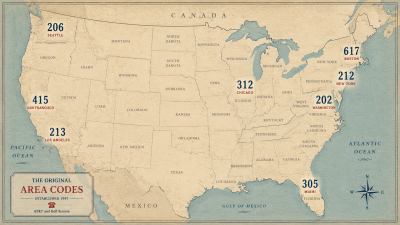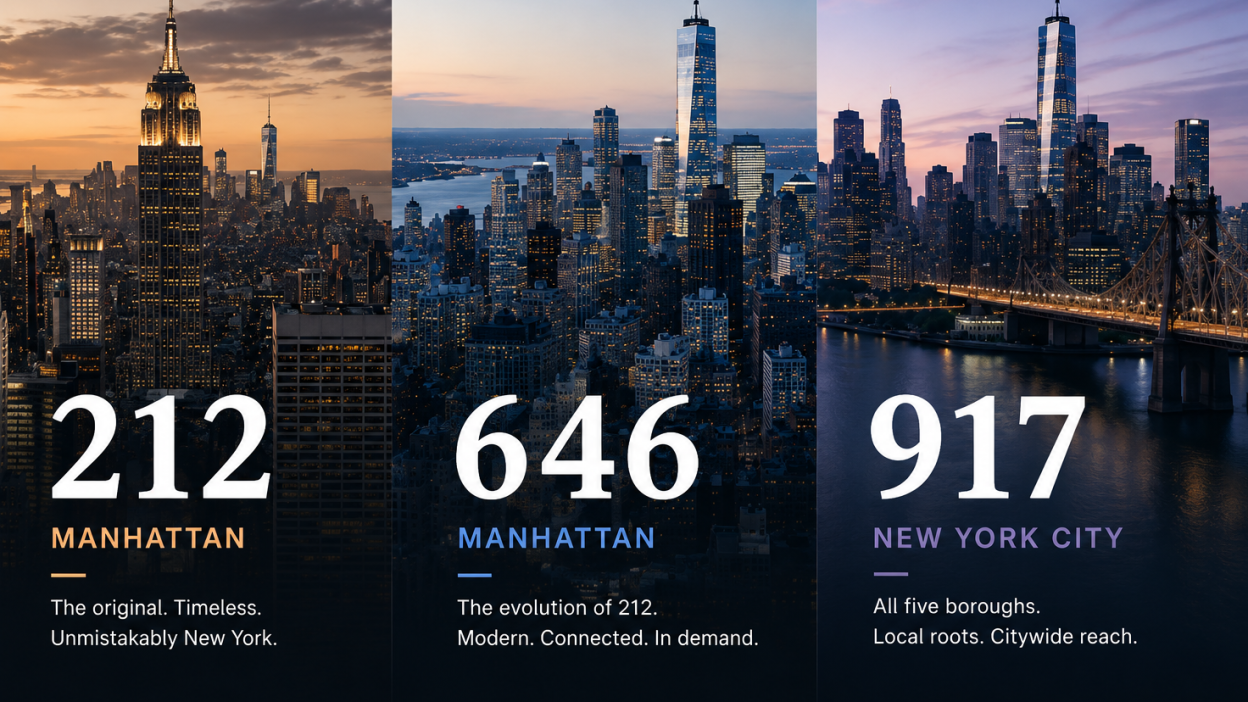
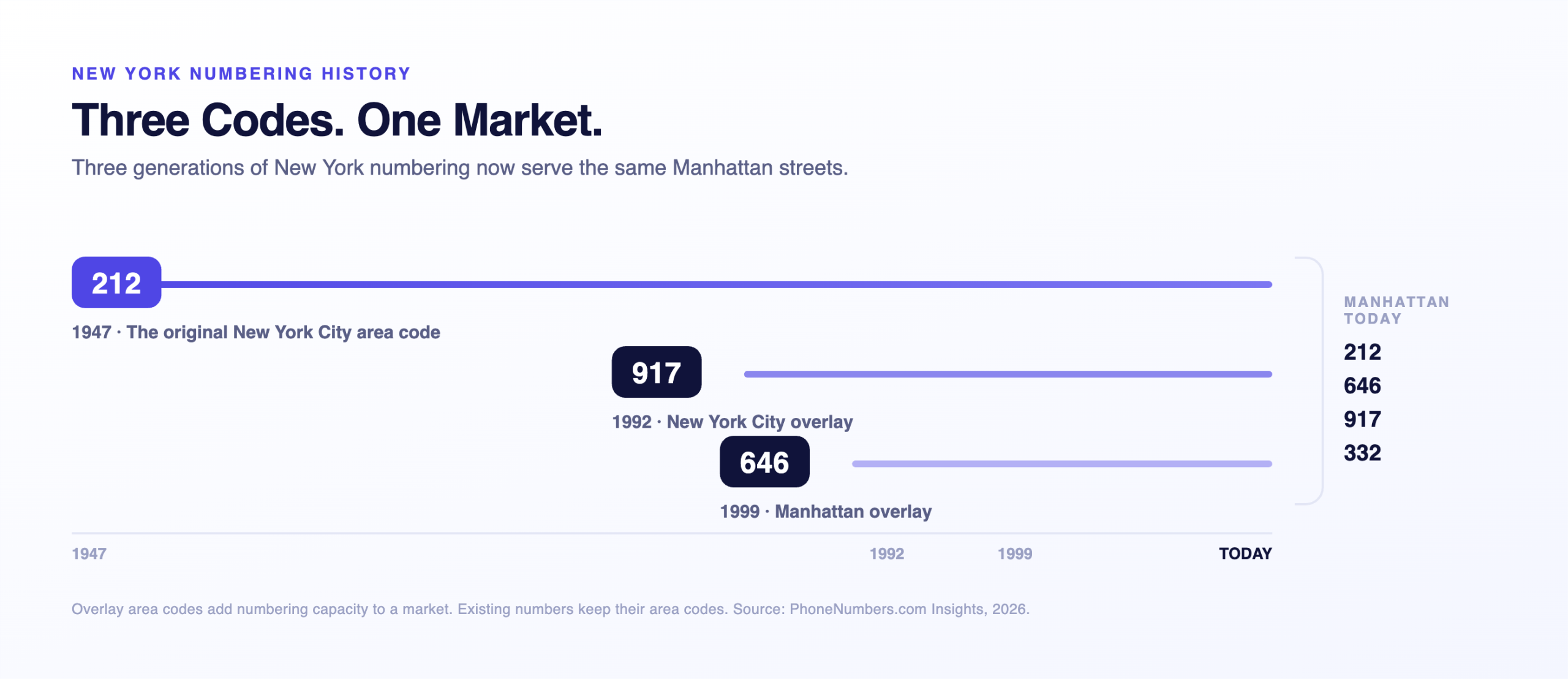
For businesses choosing a New York phone number, 212, 646 and 917 represent three generations of the city’s numbering system. 212 is the original New York City area code, introduced in 1947 and ultimately reduced to Manhattan. 917 arrived in 1992 as the city’s first overlay, initially closely associated with cellular phones and pagers. 646 followed in 1999 as a Manhattan overlay.
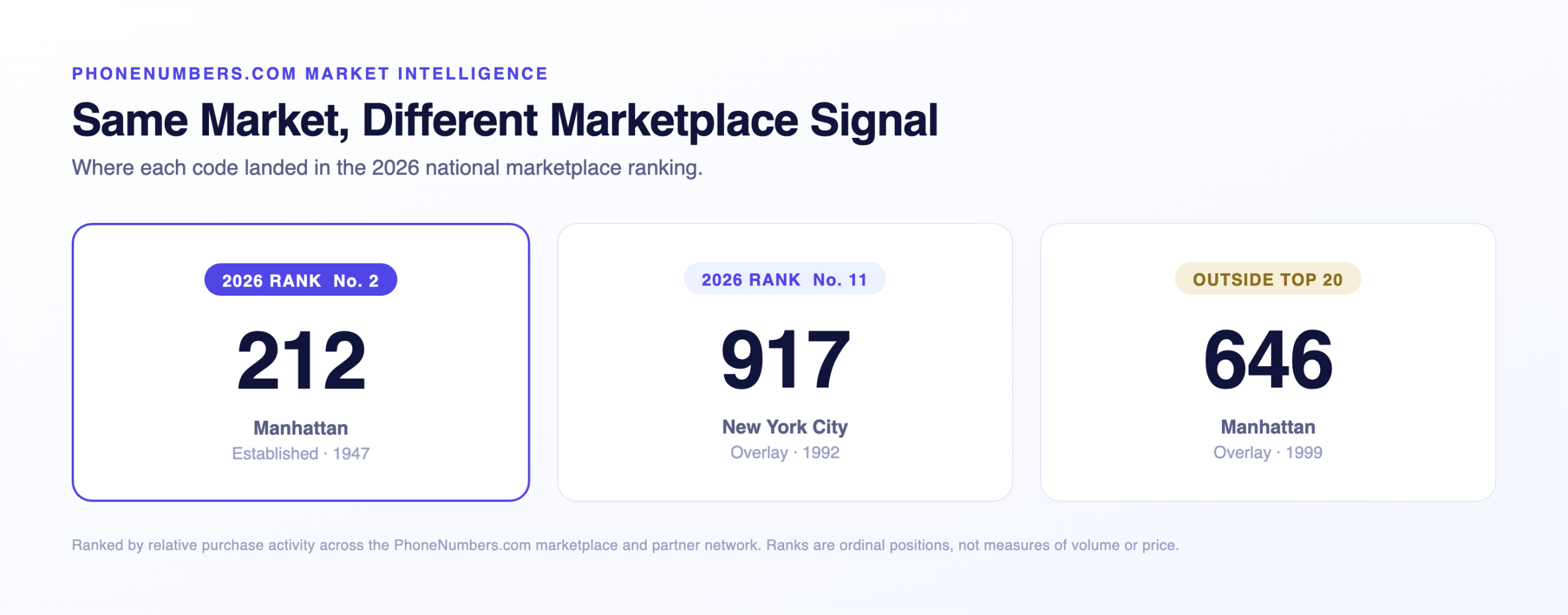
Functionally, the distinction is far smaller today: Manhattan is served by an overlay complex that includes 212, 646, 917 and 332, and existing numbers keep their area codes. From a marketplace perspective, however, the codes are not interchangeable. In the 2026 PhoneNumbers.com marketplace study, 212 ranked No. 2 nationally, 917 ranked No. 11, and 646 finished outside the Top 20.
This comparison measures relative purchase activity, not monetary value. Proprietary transaction counts are not disclosed.
Three Area Codes. Three New York Identities.
New York is a useful example of how telephone number identity evolves. A phone number is technically an addressing mechanism. But businesses and consumers do not necessarily perceive every number serving the same geographic market in exactly the same way.
Consider three numbers beginning 212, 646 and 917. All can be associated with Manhattan. Yet each entered New York’s numbering system at a different point in its history. That distinction raises a larger question:
When multiple area codes serve the same market, does the area code itself still influence buyer preference?
PhoneNumbers.com marketplace activity suggests that it can.
212 Area Code · The Original
The 212 area code dates to the original North American numbering system established in 1947. At the time, 212 covered all five boroughs of New York City. As demand for telephone numbers expanded, that territory was progressively divided: Brooklyn, Queens and Staten Island moved to 718 in the 1980s, and the Bronx later joined them, leaving 212 associated with Manhattan.
That history matters. Few American area codes have developed an association with a specific business district as strong as the connection between 212 and Manhattan. But reputation alone does not tell us what buyers actually choose.
In the 2026 marketplace analysis, 212 ranked No. 2 nationally by relative purchase activity, behind only 516. That places an area code created nearly eight decades ago ahead of almost every newer geographic area code in the study, and it suggests that the introduction of additional Manhattan area codes has not eliminated marketplace interest in 212.
One distinction is important, though: high purchase activity does not necessarily mean highest monetary value. A scarce, highly desirable number could transact less frequently while commanding a higher price. Purchase frequency and value are separate measurements, and PhoneNumbers.com treats them separately.
See Available 212 Phone Numbers →
646 Area Code · Manhattan’s Expansion
By the 1990s, Manhattan needed additional numbering capacity. Rather than geographically divide Manhattan again, regulators approved an overlay. The 646 area code was introduced in 1999, allowing new numbers to be issued while existing 212 customers kept their numbers.
That distinction is fundamental to understanding overlays. A 646 number does not represent a different section of Manhattan from a 212 number. The two codes can serve the same geographic market, which creates an unusually clean natural comparison.
If geography were the only factor determining buyer behavior, we might expect area codes serving substantially the same market to perform similarly. The 2026 marketplace data does not show that: 212 ranked No. 2 nationally, while 646 did not appear in the Top 20.
That does not prove that buyers universally prefer 212 to 646. Availability, individual number quality, memorable digit patterns, pricing and other variables can all influence transaction activity. But it does demonstrate why PhoneNumbers.com does not treat an area code as simply a geographic field. The area code itself can be part of the identity of the number.
See Available 646 Phone Numbers →
917 Area Code · A Different Kind of New York Number
The 917 area code has a different history from both 212 and 646. Introduced in 1992 as an overlay covering New York City, it was initially associated with cellular phones and pagers, and it is widely recognized as the first overlay area code in the North American Numbering Plan.
That gives 917 an unusual geographic identity. Unlike 212 and 646, which are associated specifically with Manhattan, 917 spans New York City: state regulators identify it within the Manhattan 212/646/917 region as well as the outer-borough 347/718/917/929 region.
In the 2026 study, 917 ranked No. 11 nationally. That puts it below 212, but still among the twenty geographic area codes appearing most frequently in the marketplace purchases represented in the study. 917 demonstrates that an overlay does not necessarily remain a secondary telephone identity indefinitely. Over time, an area code can develop recognition of its own.
See Available 917 Phone Numbers →
212 vs 646 vs 917 at a Glance
| 212 | 646 | 917 | |
|---|---|---|---|
| Introduced | 1947 | 1999 | 1992 |
| Core geography | Manhattan | Manhattan | New York City |
| Numbering role | Original | Manhattan overlay | NYC overlay |
| 2026 rank | No. 2 | Outside Top 20 | No. 11 |
| Business signal | Established Manhattan identity | Manhattan identity | Broader NYC identity |
The technical differences between these codes have diminished. The market identities have not necessarily disappeared with them. That is the more interesting story.
Does a 212 Number Make a Business Look More Established?
There is a temptation to answer this with an unconditional yes. The data does not justify going that far.
212’s history and close association with Manhattan are factual. Its No. 2 position in the 2026 marketplace ranking is also measurable. But neither proves how an individual customer will perceive a particular phone number. What the marketplace data does demonstrate is that 212 continues to generate substantial buyer activity despite the availability of newer alternatives serving Manhattan.
For a business, that makes 212 worth considering when Manhattan identity is important. But the area code is only three digits. A memorable 646 or 917 number may be more useful to a business than a difficult-to-remember 212 number. That leads to a principle that appears repeatedly in PhoneNumbers.com marketplace data:
Area code matters. The seven digits after it matter too.
Is 646 Less Desirable Than 212?
Not necessarily. What we can say is narrower and more defensible: 212 appeared substantially more frequently in the purchases represented in the 2026 study. That is a measure of marketplace activity, not a universal measure of desirability and not a price index.
Consider two hypothetical numbers: 212-555-1947 and 646-FLOWERS. A buyer whose priority is Manhattan area code recognition might prefer the first. A florist whose priority is memorability and advertising response might strongly prefer the second.
The correct question therefore is not which area code is always better. It is which combination of area code, number pattern, availability and business purpose creates the strongest phone identity. That is a much more useful way to evaluate a number.
917 Occupies an Unusual Middle Ground
917 is particularly interesting because it does not fit neatly into an original-versus-overlay comparison. Technically, it is an overlay. Historically, however, it has been part of New York’s numbering environment since 1992 and initially had a distinctive relationship with mobile service. Its No. 11 position suggests that newer does not automatically mean weaker.
The same pattern appears elsewhere in the 2026 research. 747, an overlay in the Los Angeles region, ranked No. 3 nationally, above numerous established area codes. 929, a New York overlay, ranked No. 4. So the broader data does not support a simple rule that original equals desirable and overlay equals undesirable. Buyer behavior is more complicated.
What Businesses Should Consider When Choosing a New York Number
For a business selecting between 212, 646 and 917, we would evaluate at least four things.
1. Geographic identity
If specifically signaling Manhattan matters, 212 and 646 provide the clearest geographic association. 917 communicates New York City more broadly.
2. Number quality
Do not evaluate the first three digits independently from the remaining seven. Repeated digits, sequences, memorable endings and vanity patterns can materially change the usefulness of a number.
3. Availability
A theoretically perfect area code is not particularly useful if the available numbers do not fit the business. The strongest choice is often the best combination actually available.
4. Intended use
A professional services firm, a local restaurant, a national advertiser and an inbound sales organization may evaluate the same numbers differently. There is no universally best New York area code independent of the number and its use case.
What the Rankings Tell Us About New York
The comparison becomes even more interesting beyond these three codes. Five New York area codes appear in the 2026 Top 20: 516 at No. 1, 212 at No. 2, 929 at No. 4, 917 at No. 11 and 718 at No. 17.
New York therefore occupies multiple positions near the top of the marketplace ranking rather than concentrating buyer activity in a single iconic area code. That matters for number intelligence: telephone identity within a metropolitan market can become layered rather than simply replaced. New area codes do not necessarily erase the identity of those that came before them. They can create additional identities alongside them.
From Area Codes to Number Intelligence
The 212 versus 646 versus 917 comparison illustrates a larger problem with evaluating phone numbers using geography alone. An area code tells us something important. It does not tell us everything.
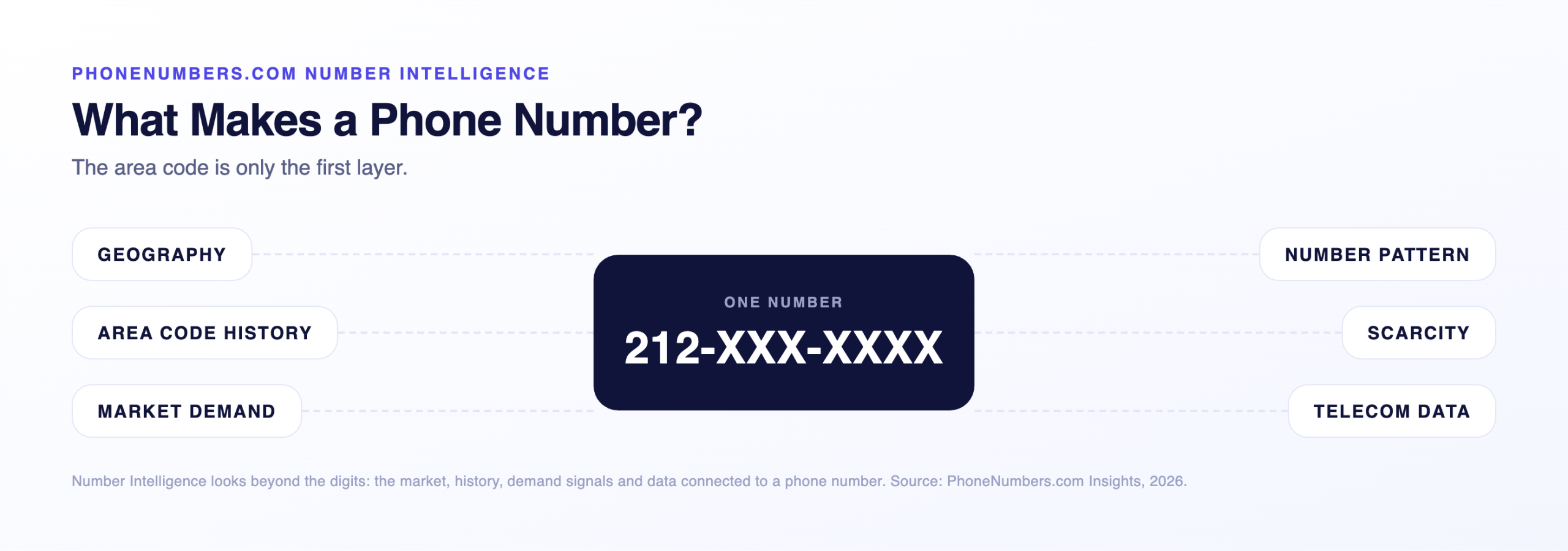
A complete understanding of a phone number can involve multiple layers: the geography associated with the number, the history of its area code, how frequently that code appears in marketplace transactions, whether the complete number is memorable or distinctive, what comparable numbers are actually available, and the telecommunications data connected to the number itself.
This is the broader purpose of PhoneNumbers.com Number Intelligence: moving beyond the digits themselves to understand the information, history and market signals connected to a phone number.
Frequently Asked Questions
Which is better, 212 or 646?
Neither is universally better. Both can serve Manhattan, but they entered the numbering system at different times. In the 2026 PhoneNumbers.com marketplace study, 212 ranked No. 2 nationally while 646 was outside the Top 20. That measures relative purchase activity, not the value of every individual number.
Is 917 a Manhattan area code?
917 can serve Manhattan, but unlike Manhattan-focused 212 and 646, 917 serves New York City more broadly. It was introduced in 1992 as a citywide overlay.
Is 646 an overlay of 212?
Yes. 646 was introduced in 1999 as additional numbering capacity for Manhattan rather than dividing the existing 212 territory into another geographic area.
Is 917 older than 646?
Yes. 917 was introduced in 1992; 646 followed in 1999.
Does Manhattan have area codes besides 212, 646 and 917?
Yes. 332 was added to the Manhattan overlay complex beginning in 2017.
Does a 212 number cost more than a 646 or 917 number?
Not necessarily. The area code is only one factor in a phone number’s market value. The individual seven-digit pattern, memorability, scarcity, availability and buyer demand can also matter. The 2026 rankings measure relative purchase activity, not price.
Which New York area code ranked highest in the PhoneNumbers.com study?
516 ranked No. 1, followed by 212 at No. 2. Among the three codes compared in this article, 212 ranked highest.
Methodology
PhoneNumbers.com analyzed marketplace transaction activity across PhoneNumbers.com and its partner network to identify the geographic area codes appearing most frequently in completed phone number purchases. The rankings represent relative purchase activity within the analyzed marketplace dataset. They do not establish the monetary value of an individual phone number.
About This Research
PhoneNumbers.com Insights publishes original research and analysis on the phone number market, including area codes, premium and vanity numbers, toll-free numbers and number intelligence. Our research combines proprietary marketplace signals with telecommunications data to better understand how businesses and consumers select, use and value phone numbers.
Explore Area Code Intelligence → Explore Number Intelligence →
See Available New York Phone Numbers →
More from PhoneNumbers Insights
Area codes
- America’s Most In-Demand Area Codes of 2026
- The Original Area Codes: Why Legacy Codes Still Matter
- The Intelligence Behind an Area Code
Toll-free numbers
- 800 vs 888 vs 877: Which Toll-Free Prefix Is Best?
- The Evolution of Toll-Free Numbers: From 800 to 833
- Local vs Toll-Free Numbers: Which Is Right for Your Business?
Choosing & buying a number
- How to Choose a Business Phone Number
- How to Get a Vanity Phone Number for Your Business
- What Makes a Phone Number Valuable?
- The Anatomy of a Memorable Phone Number