When you activate a new phone line, it is natural to think you have received a new phone number. But new often means newly assigned to you. It does not necessarily mean never used before. Telephone numbers are finite numbering resources: when customers disconnect service, numbers can eventually return to the available pool and be assigned to someone else.
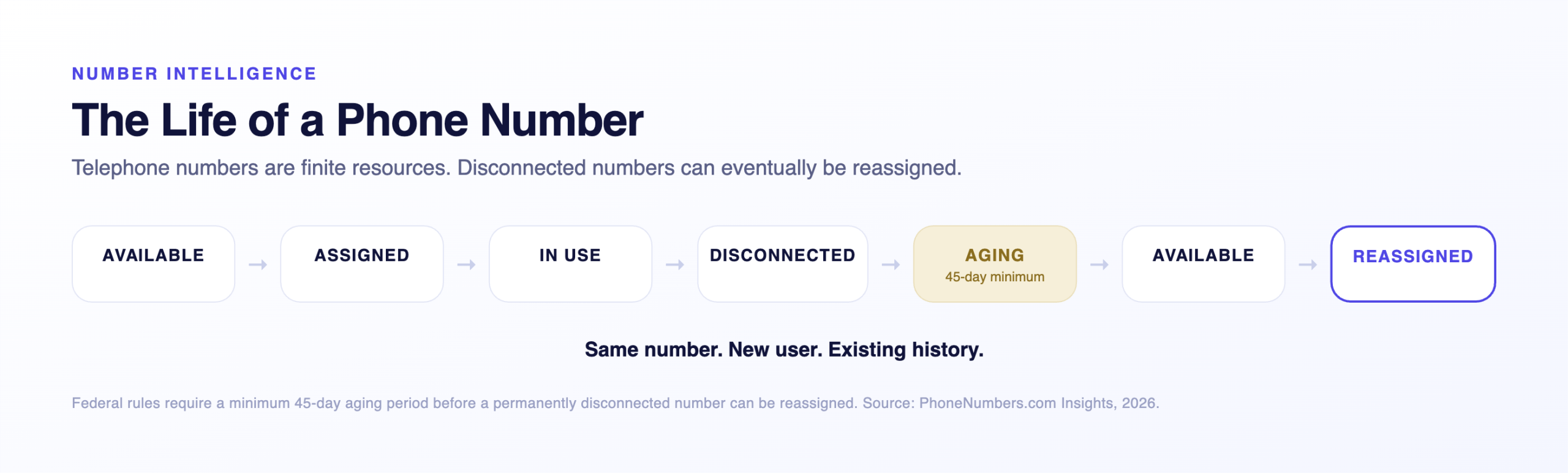
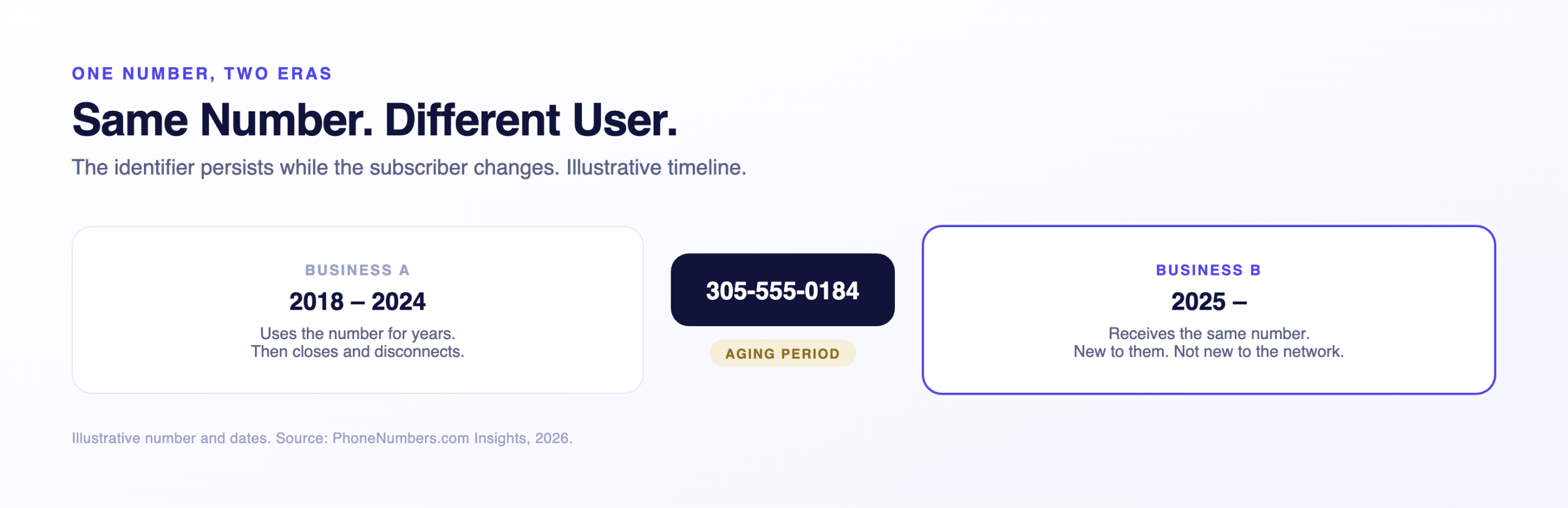
The Federal Communications Commission specifically recognizes this lifecycle. After a number is permanently disconnected, it enters an aging period, with federal rules establishing a minimum of 45 days before it can be reassigned. After that process, the same ten digits can belong to a completely different customer. The number remains the same. The person, business, carrier and context around it may not.
New to You Does Not Necessarily Mean New
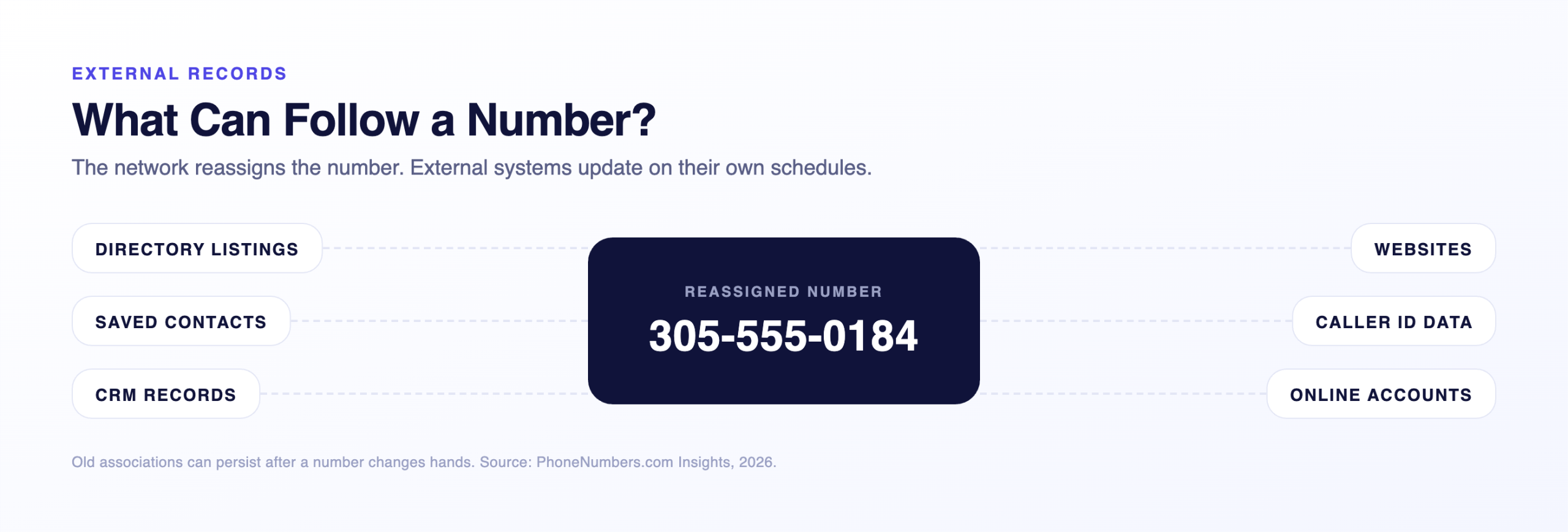
Consider an illustrative number: 305-555-0184. Imagine it was used by a business for several years. The business closes, its telephone service is disconnected, the number goes through the required aging process, and eventually it becomes available again. A new customer receives 305-555-0184. To that customer, it is a new number. But the number itself has a history.
It may have appeared previously on business directories, websites, customer contact lists, marketing materials, online accounts, caller identification databases or other third-party datasets. Some of those associations may disappear quickly. Others may persist. That is the fundamental issue with reassigned numbers:
A telephone number can change users faster than every external system associated with that number changes its records.
The Lifecycle of a Phone Number
A simplified telephone number lifecycle runs from available, to assigned, to active use, to disconnected, to aging, to available again, and potentially to reassigned. That cycle can repeat. The aging stage is the deliberate pause in the middle: a period during which a permanently disconnected number is temporarily unavailable for assignment to another user.
What Is an Aging Number?
The FCC describes an aging number as a disconnected telephone number that is temporarily unavailable for assignment to another end user. The purpose is straightforward: if a number moved instantly from one customer to another, calls intended for the previous customer could immediately begin reaching the new one. The aging period creates separation between those assignments.
Current federal rules require a minimum 45-day aging period before permanently disconnected numbers can be reassigned, a minimum the FCC adopted in part to reduce calls intended for previous users from reaching new subscribers. The FCC has also historically set maximum aging periods to encourage efficient use of the finite numbering supply. So aging balances two objectives: give the old assignment time to clear, while returning unused numbering resources to productive use.
Why Are Phone Numbers Reused?
The North American Numbering Plan contains an enormous number of possible telephone numbers, but those resources are not unlimited. Numbers are organized within area codes, central office codes, thousands blocks, rate centers and other numbering structures, and service providers are expected to use their numbering resources efficiently.
Holding disconnected numbers indefinitely would unnecessarily consume numbering capacity. Reassignment allows resources to be reused. From the perspective of numbering administration, this is efficient. From the perspective of the next person receiving the number, it introduces an interesting issue: the number may arrive with history attached.
What Can Follow a Reassigned Number?
The telephone network can reassign a number. That does not mean every database outside the telephone network immediately understands that the user changed. Friends, customers or business associates of the previous user may still have the number saved. Old directory listings may continue to associate it with a previous company. It can remain on abandoned webpages and cached content. Businesses may retain it in CRM and account records. Automated systems may continue attempting to reach the previous user. Third-party caller identification datasets may retain previous associations until their records are updated.
The result can be confusing: a completely legitimate new subscriber can receive calls or messages intended for someone who has not controlled the number for months, or longer.
This Problem Has Its Own Federal Database
Reassigned numbers are not a theoretical telecommunications edge case. The FCC created the Reassigned Numbers Database, or RND, specifically to help callers determine whether a number has been permanently disconnected since they last had consent to contact the person associated with it. Voice service providers and the toll-free numbering administrator report permanently disconnected numbers into the system.
The reasoning was simple. A caller may legitimately have been given a phone number by one consumer. That consumer later disconnects the number. The number is reassigned. The caller does not know, and the next call reaches a completely different person. The RND was designed to help reduce exactly that problem.
A Number Can Keep Its Past Associations
This is one of the most important concepts in Number Intelligence. A telephone number has at least two different kinds of history. Telecommunications history: assignment, disconnection, portability and carrier related changes. External history: the places where the number appeared and the entities with which it was associated.
Those histories do not necessarily update at the same speed. A carrier can complete a reassignment, but an old webpage may remain online, a CRM may retain an outdated record, and a third-party dataset may still connect the number to a previous business. So reassignment creates a separation between who controls the number now and what historical information may still exist about it.
Does Every Reassigned Number Have a Problem?
No, and this distinction is important. A previously used number is not inherently a bad number. Most previous use may have no meaningful effect on the next customer at all.
The existence of a previous assignment does not establish that the previous user was problematic, that the number has a poor reputation, that the new user will receive unwanted calls, or that the number should be avoided. It establishes only that the same telephone number may have existed in a different context before its current assignment. Anything beyond that requires additional evidence.
Number History Is Not Number Reputation
These concepts should be separated. Number history asks what can be established about the number’s previous telecommunications or assignment context. Number reputation asks what external signals or classifications have become associated with the number.
A number can have history without any negative reputation. Likewise, a reputation dataset may contain outdated information that no longer describes the current user. This is why PhoneNumbers.com believes number intelligence should distinguish fact from signal from inference. The fact that a number was reassigned may be verifiable. A third-party label associated with that number is a separate data point requiring its own context.
What About Ported Numbers?
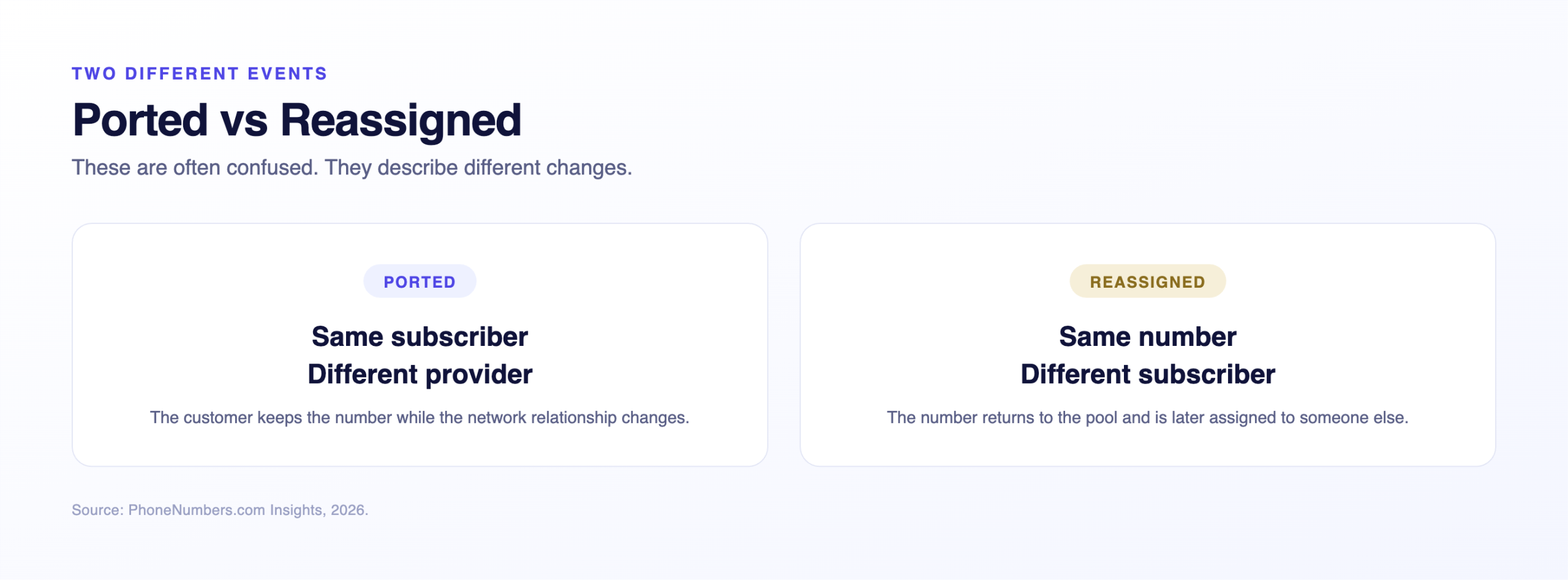
Reassignment and portability are different events. Under reassignment, the user changes: the number is eventually assigned to another customer. Under portability, the user generally keeps the number while changing compatible service providers: the number remains associated with the same subscriber while the network relationship changes.
This distinction matters when interpreting carrier information. A prefix may historically have been associated with one carrier, but because numbers can be ported, that original allocation does not necessarily identify the carrier currently serving an individual number. For the broader framework, see Look Beyond the Digits.
The Number May Be Old Even When the Area Code Is New
Area code age and individual number history are also separate concepts. A number in an established area code such as 212 may have changed users multiple times. A number in a newer overlay could have had fewer assignments. But neither can be assumed simply from the area code. Area Code Intelligence tells us about the numbering region. Number history tells us about the individual telephone number. Those are different layers of intelligence.
Why Businesses Should Care
For a consumer, an occasional call intended for a previous subscriber may simply be annoying. For a business, a phone number can become a long-term identity. It may appear on websites, advertising, business cards, vehicles, signage, customer records, social profiles, search listings, contracts and account systems. Changing it later can be expensive and disruptive.
That makes the quality of a number potentially more important for a business than for someone choosing a temporary personal line. A business selecting a permanent number may reasonably want to understand more about that number before building its identity around it.
A Different Approach: New, Never-Assigned Numbers
Reassigned numbers are common across the telecommunications industry, but not every available number has a previous subscriber.
The numbers offered through the PhoneNumbers.com marketplace are new telephone numbers that have never previously been assigned to an end user. That distinction matters for businesses selecting a number they may use for years. A previously assigned number can carry historical associations from an earlier user, while a never-assigned number begins without a prior subscriber history.
This does not mean every reassigned number presents a problem. Most may not. But for businesses choosing a long-term communications identity, knowing whether a number has previously been assigned is another useful piece of Number Intelligence.
A Phone Number Can Outlive the Business Using It
Consider a business that operates for fifteen years using the same number. During that time the number may spread across thousands of records and websites. Eventually the business closes, the number is disconnected, and after the required aging process it may eventually be reassigned. But the digital footprint of the old business may remain.
This creates an unusual characteristic of phone numbers: the communications asset can survive the organization that once used it. Domains can have histories. Buildings can have histories. Brands can have histories. Phone numbers can too.
Why History Can Matter to Premium Numbers
The issue becomes particularly interesting with memorable or premium phone numbers. A strong number may have been desirable to more than one business over its lifetime. That does not inherently reduce its value; in some cases, the number’s memorable structure is precisely why different businesses wanted it.
But a buyer evaluating a long-term premium number may still want to understand available historical context. The right question is not whether anyone has ever used the number before. The more useful question is whether anything in the available history matters to how the buyer intends to use the number. That is a Number Intelligence question.
Historical Data Has Limits
Telephone number history should never be presented with false precision. No single public dataset necessarily contains a perfect lifetime record of every person, business, carrier and application associated with every telephone number. Records may be incomplete, outdated, conflicting, unavailable or limited to particular periods or providers.
A responsible Number Intelligence system should therefore distinguish between verified telecommunications data (current or authoritative numbering and network information), historical records (previous associations supported by available data), third-party signals (information appearing in external datasets) and inference (conclusions derived from multiple signals). Those categories should not be presented as though they have equal certainty.
The Intelligence Behind Number History
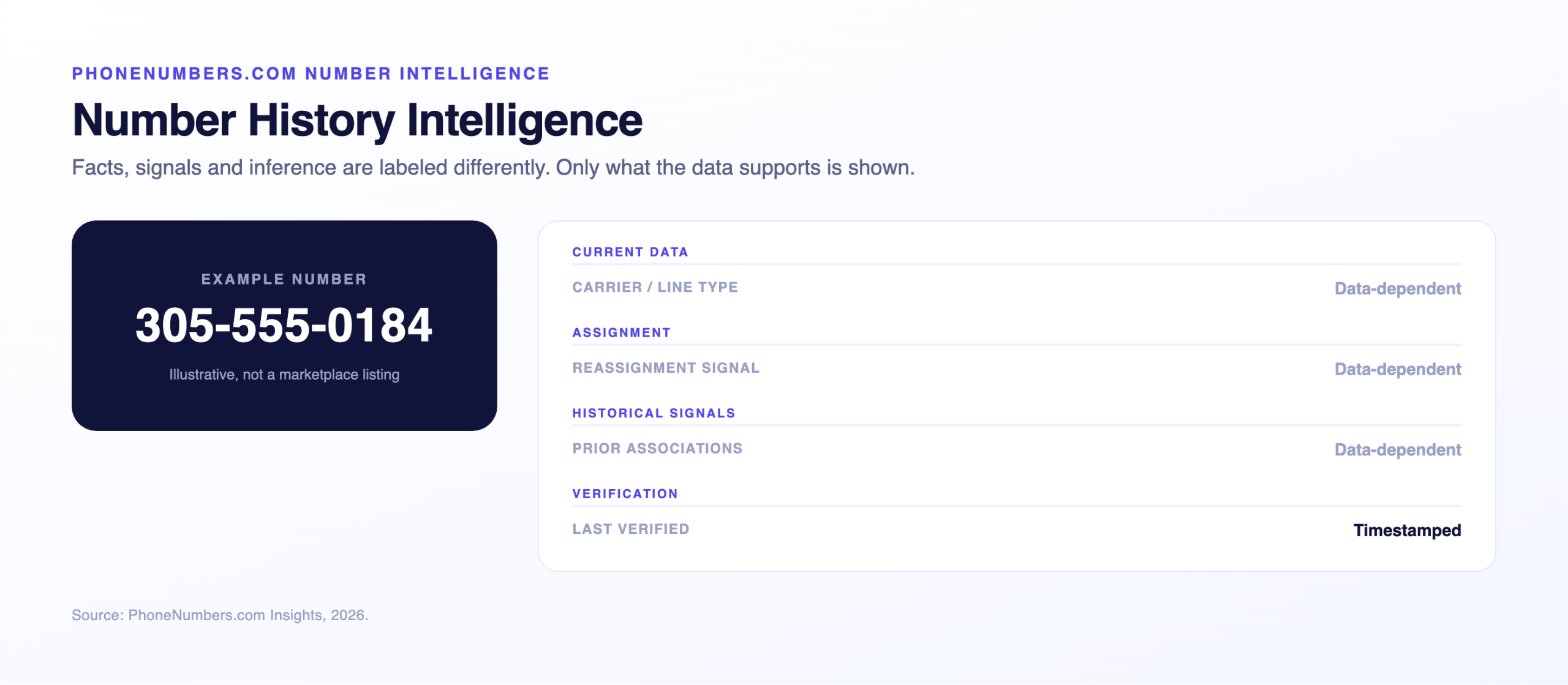
A useful Number Intelligence profile could eventually bring several historical signals together: the number’s numbering facts, its current telecom attributes, assignment signals such as recent disconnection or reassignment, and external signals such as historical business associations and directory references. The phrase data-dependent matters: we should only display what the available sources actually support.
From Number History to Number Intelligence
Knowing that phone numbers can be reassigned changes how we should think about them. The visible number is only the identifier. Behind it may be a timeline: assigned, used, ported, disconnected, aged, reassigned, used again. Different points in that timeline can produce different data.
That creates an opportunity for Number Intelligence to become temporal. Not simply what is this number, but what do we know about this number now, and what do we know about how its context has changed. That is a much richer question.
Why This Matters for B2B Data
Businesses frequently maintain databases containing phone numbers, and those records can become stale when numbers change hands. A company may believe a number belongs to Customer A. But Customer A disconnected it months ago, and the number now belongs to Customer B. Without reassignment intelligence, the database still appears correct.
This matters for CRM systems, customer communications, account verification, contact databases, messaging platforms, collections, healthcare communications, financial services and customer support: anywhere organizations rely on telephone numbers as persistent identifiers. The number may persist. The person behind it may not.
A Phone Number Is Not a Permanent Identity
This is perhaps the most important lesson. Businesses often treat a telephone number as though it were permanently tied to a person. It is not. A phone number is a communications identifier assigned for use. That assignment can end, the number can return to the numbering pool, and another subscriber can receive it.
A system that treats telephone number as permanent person is making an assumption the numbering system itself does not support. That has implications for data quality, identity resolution and customer communications.
APIs Can Make Reassignment Intelligence Actionable
This is where the concept moves from research to infrastructure. Instead of manually investigating numbers, a business system could query relevant number intelligence sources programmatically:
number:                +1 305 555 0184
current_status:        [data-dependent]
carrier:               [data-dependent]
line_type:             [data-dependent]
portability:           [data-dependent]
reassignment_signal:   [data-dependent]
last_verified:         [timestamp]
A CRM could check records. A communications platform could enrich numbers. A business could evaluate data quality. An AI system could incorporate reassignment context before drawing conclusions about a number. The value is not simply knowing that reassignment exists. It is making that intelligence usable at scale.
AI Makes Historical Context Easier to Interpret
Historical telephone data can become complicated quickly: one source may show a carrier change, another a previous business association, another a disconnect signal. AI can help summarize those signals. Asked what to know about a number, a useful system might eventually answer that it is a Miami-area number, that current telecommunications data indicates particular attributes, that available records suggest the number may have been reassigned after a prior disconnection, and that historical associations should not be assumed to describe the current subscriber.
The important part is not the prose. It is the underlying evidence. AI should interpret the data. It should not invent the history.
Before Building a Business Around a Number
A business selecting a long-term number should evaluate more than whether it rings. Consider the area code (does it communicate the right geographic or national identity?), the complete number (is it memorable?), the pattern (does it contain useful repetition, sequences or vanity potential?), the history (is relevant historical information available?), the current telecom data (what can be verified today?) and the intended use (will this become a permanent part of the company’s identity?).
For an important business number, those questions can be worth asking before the number appears everywhere. Our guide to what makes a phone number valuable covers the evaluation framework in full.
New and Never Assigned Are Not the Same Thing
The telecommunications system is designed to make numbers reusable. That is efficient. But it also means the number assigned today may not have begun its life with you. The digits may have appeared on another phone, represented another business, moved between carriers, been disconnected, aged and returned to service. Most of that history may never matter. Sometimes it might.
A number newly issued by a provider may have belonged to another subscriber before. That is why assignment history can be an important part of understanding a phone number. At PhoneNumbers.com, the numbers offered through our marketplace are new, never-assigned numbers, giving businesses the opportunity to establish the first subscriber identity associated with the number.
Frequently Asked Questions
Are phone numbers reused?
Yes. Permanently disconnected telephone numbers can eventually be made available for reassignment to another subscriber. The FCC’s numbering rules specifically provide for this process.
How long before a disconnected phone number can be reassigned?
FCC rules establish a minimum aging period of 45 days before a permanently disconnected number can be reassigned. Other rules and circumstances can affect how long a number actually remains unavailable.
Does a new phone number mean it has never been used?
No. A number that is newly assigned to you may previously have been assigned to another customer.
Can I receive calls intended for the previous owner?
Yes, it is possible. Reducing unwanted calls to people who received reassigned numbers was a primary reason the FCC established its Reassigned Numbers Database.
Does a previous owner make a phone number bad?
No. Previous use alone says nothing about the quality or reputation of the number.
Can a reassigned number still appear under the previous owner’s name?
It is possible for third-party databases, directories or other external systems to contain outdated information after a number changes users. That information should not automatically be assumed to describe the current subscriber.
Is porting the same as reassignment?
No. Portability generally allows a customer to retain a number while changing compatible service providers. Reassignment occurs when a disconnected number eventually becomes assigned to a different customer.
Can I find the complete history of a phone number?
Not necessarily. Available records vary, and no single dataset should be assumed to contain a complete lifetime history of every telephone number.
What is the Reassigned Numbers Database?
The RND is an FCC-established database designed to help callers determine whether a telephone number has been permanently disconnected since a particular date, helping reduce calls intended for previous subscribers from reaching new users.
Are the numbers sold on PhoneNumbers.com previously owned?
The numbers offered through the PhoneNumbers.com marketplace are new telephone numbers that have never previously been assigned to an end user.
About PhoneNumbers.com Number Intelligence
A phone number is not simply a static string of digits. Its context can change over time as numbers are assigned, ported, disconnected and reassigned. PhoneNumbers.com is building toward a structured Number Intelligence platform designed to bring together telecommunications, numbering, marketplace and historical signals while clearly distinguishing verified facts from contextual data and inference.
Because understanding a number means understanding more than what it looks like today.
Look Beyond the Digits → Explore Number Intelligence → Explore Area Code Intelligence →
More from PhoneNumbers Insights
Area codes
- America’s Most In-Demand Area Codes of 2026
- 212 vs 646 vs 917: Understanding New York’s Most Recognized Area Codes
- The Original Area Codes: Why Legacy Codes Still Matter
- The Intelligence Behind an Area Code
Toll-free numbers
- 800 vs 888 vs 877: Which Toll-Free Prefix Is Best?
- The Evolution of Toll-Free Numbers: From 800 to 833
- Local vs Toll-Free Numbers: Which Is Right for Your Business?
Choosing & buying a number
- How to Choose a Business Phone Number
- How to Get a Vanity Phone Number for Your Business
- What Makes a Phone Number Valuable?
- The Anatomy of a Memorable Phone Number