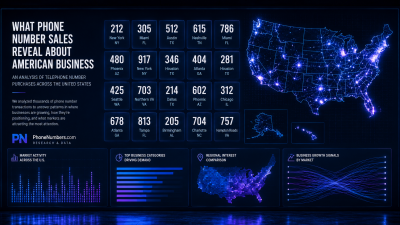
Phone numbers are everywhere, but the market behind them is rarely examined with much depth.
Every day, businesses choose numbers based on location, memorability, brand value and customer recognition. Area codes develop identities of their own. Certain number patterns become more desirable than others. Toll-free prefixes compete for attention. Numbers are reassigned, ported between carriers and connected to an increasingly complex layer of telecommunications data.
PhoneNumbers.com Insights was created to study that market.
Our goal is straightforward: combine real marketplace activity, telecommunications expertise and original research into a better understanding of phone numbers, how they’re used, how they’re valued and how the market changes over time.
Research Built on Real Marketplace Activity
A large part of what you’ll find here will come from something most publishers covering phone numbers don’t have: actual marketplace data.
PhoneNumbers.com operates a marketplace for premium, vanity, local and toll-free phone numbers, alongside number intelligence and telecommunications services.
That gives us the opportunity to examine questions such as:
- Which area codes attract the most buyer demand?
- Which markets are gaining or losing momentum?
- What types of numbers command premium prices?
- Which number patterns appear most frequently in purchases?
- How does demand differ between local and toll-free numbers?
- Which industries are buying particular types of numbers?
- How does phone number demand change over time?
Where we publish marketplace research, we’ll explain the methodology and distinguish what the data shows from our interpretation of it.
The objective isn’t to manufacture statistics for a headline. It’s to let the data tell us what’s happening.
Area Code Intelligence
An area code is technically part of a telephone numbering system. In practice, it can mean much more.
Codes such as 212, 305, 310 and 202 are closely associated with the markets they serve. At the same time, continued demand for telephone numbers has resulted in overlays that place multiple area codes within the same geographic market.
PhoneNumbers.com maintains a directory covering hundreds of US and NANP area codes, including geographic codes, overlays and toll-free prefixes.
Area Code Intelligence will go beyond simply telling you where an area code is located. We’ll examine demand, recognition, history, overlays and marketplace behavior to understand how different area codes perform and why buyers choose them.
One of our first major research projects will examine exactly that: America’s Most In-Demand Area Codes of 2026. Rather than ranking area codes according to population or anecdotal popularity, we’ll analyze actual marketplace activity to identify which codes buyers are choosing.
As our historical marketplace data is compiled and validated, we’ll also look at how those rankings have changed over time.
Premium & Vanity Numbers
Two phone numbers can provide exactly the same basic telecommunications function while having dramatically different levels of memorability and market demand. Why?
Sometimes it’s the area code. Sometimes it’s a recognizable word or brand. Sometimes it’s the structure of the digits themselves. Repeating numbers, sequences, round numbers and other distinctive patterns can make a number substantially easier to recognize and remember.
That’s where the premium number market gets interesting. Our Premium & Vanity coverage will examine the characteristics that influence desirability: area code, pattern, scarcity, memorability, vanity spelling, commercial relevance and marketplace demand.
We’ll also look critically at some of the conventional wisdom surrounding vanity and premium numbers. Not every clever-looking number is valuable. And a high asking price doesn’t, by itself, establish market value. Our research will focus wherever possible on observable marketplace behavior rather than assumptions.
Toll-Free Intelligence
Toll-free numbering has evolved considerably. The original 800 prefix was eventually joined by 888, 877, 866, 855, 844 and 833, creating a much larger national numbering pool.
Technically, these prefixes all serve the toll-free numbering system. From a branding and marketplace perspective, however, interesting questions remain.
Does 800 carry greater recognition? Are certain prefixes more desirable? How much does the number following the prefix matter compared with the prefix itself? When should a business choose a local number instead?
Those are exactly the kinds of questions Toll-Free Intelligence will investigate.
Number Intelligence
There is also another side of the phone number ecosystem that has little to do with buying or selling numbers: the data behind the number.
PhoneNumbers.com provides carrier and line data tools alongside reverse lookup and marketplace services. A number can have a carrier relationship, line classification, geographic context and history. Numbers can also move between carriers through portability and eventually be reassigned.
Understanding those signals matters to businesses, consumers and telecommunications professionals for different reasons. Our Number Intelligence coverage will explore those systems without turning complex telecom subjects into generic technology content.
A Different Kind of Telecom Publication
There are already thousands of articles explaining how phone numbers work. We don’t need to produce another version of everything that’s already been written.
The opportunity for PhoneNumbers.com Insights is different. We want to publish material that benefits from the position we’re actually in: marketplace data, phone number listings, telecommunications infrastructure, number intelligence and years of experience operating inside the phone number market.
That means some Insights articles will be research reports. Others will analyze a particular area code, number category or market trend. Some will answer practical questions for businesses evaluating a number. And occasionally we’ll dig deeply into an obscure corner of telephone numbering simply because the underlying data reveals something interesting.
What’s Coming Next
We’re beginning with several areas where we believe PhoneNumbers.com can contribute original information rather than simply repeat what’s already available.
Upcoming research will examine topics including America’s most in-demand area codes, the characteristics that make certain phone numbers more valuable, the differences between toll-free prefixes, the evolution of legacy area codes, memorable number patterns and the intelligence associated with individual phone numbers.
And as the marketplace generates more data, the research will continue to evolve.
Because phone numbers may look like ten simple digits. The market behind them is anything but simple.
More from PhoneNumbers Insights
Area codes
- America’s Most In-Demand Area Codes of 2026
- 212 vs 646 vs 917: Understanding New York’s Most Recognized Area Codes
- The Original Area Codes: Why Legacy Codes Still Matter
- The Intelligence Behind an Area Code
Toll-free numbers
- 800 vs 888 vs 877: Which Toll-Free Prefix Is Best?
- The Evolution of Toll-Free Numbers: From 800 to 833
- Local vs Toll-Free Numbers: Which Is Right for Your Business?
Choosing & buying a number
- How to Choose a Business Phone Number
- How to Get a Vanity Phone Number for Your Business
- What Makes a Phone Number Valuable?
- The Anatomy of a Memorable Phone Number