
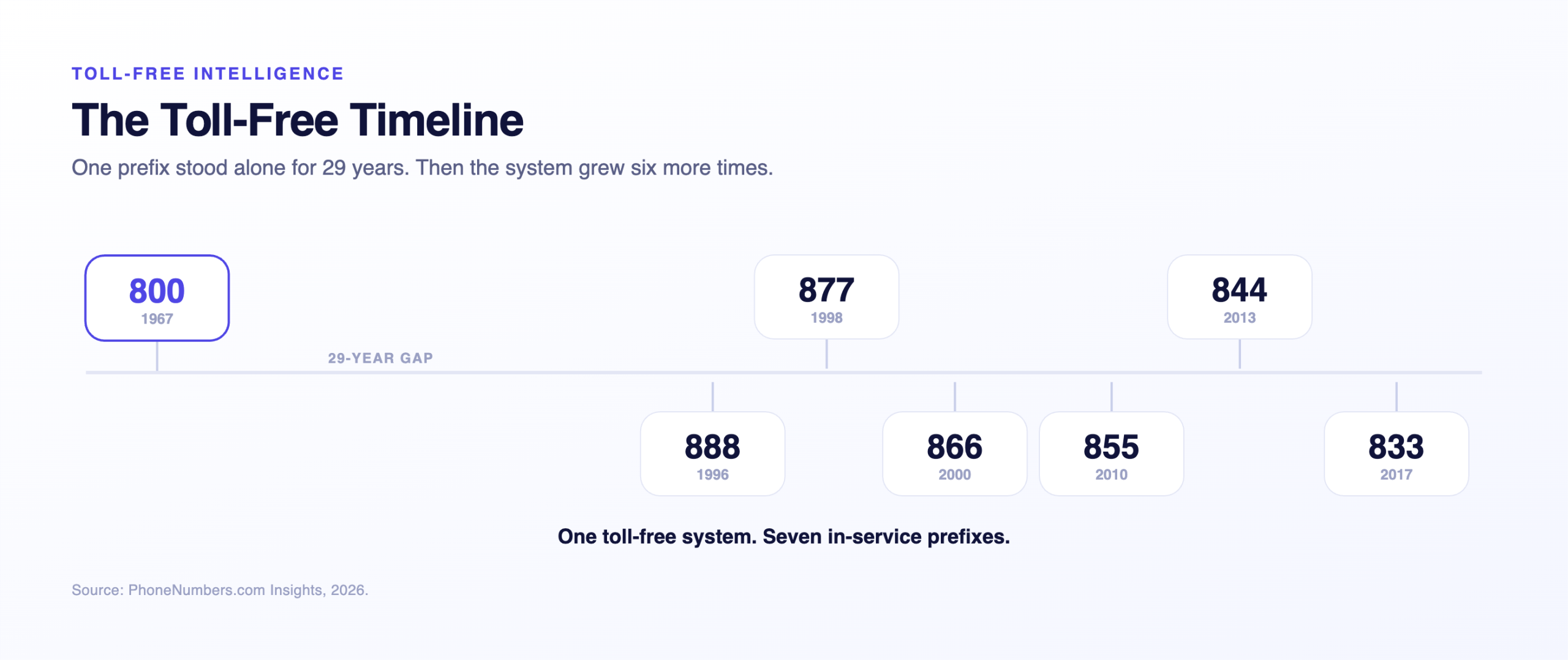
For decades, “800 number” was effectively synonymous with “toll-free number.” That made sense: 800 was the original toll-free prefix, introduced in 1967, and it stood alone until growing demand required 888 in 1996, followed by 877 in 1998, 866 in 2000, 855 in 2010, 844 in 2013 and 833 in 2017.
The expansion tells a larger story. Toll-free numbers evolved from a network feature into business identities, advertising assets, vanity numbers and programmable communications resources. And as additional prefixes entered service, businesses gained more choices and a new question: does the prefix matter, or does the complete number matter more? The answer is increasingly clear. History matters. Availability matters. But the complete number is what the customer ultimately remembers.
It Started With 800
Toll-free service was first offered by AT&T in 1967. The proposition was straightforward: allow callers to reach a business or organization without paying the long-distance charge associated with the call. That was meaningful in an era when long-distance calling could represent a significant cost.
Businesses could give customers a single number to call from across the country. The caller did not need to understand where the company was physically located, because the area code itself was not geographic. It represented something else: toll-free access. Over time, 800 became so closely associated with the concept that people commonly referred to virtually any toll-free number as an 800 number. The prefix had become bigger than its technical role. It had become a category.
800 Became a Business Identity
The value of toll-free service quickly extended beyond who paid for the call. For businesses, an 800 number could provide a national telephone identity, one number across multiple markets, centralized customer service, advertising response, lead generation and brand recognition. The number appeared in television commercials, radio advertising, newspapers, direct mail, catalogs, billboards, packaging and customer service materials.
That changed the role of the number. It was not simply infrastructure anymore. It became customer-facing identity infrastructure.
Vanity Numbers Changed What a Phone Number Could Do
Toll-free numbers became particularly powerful when digits were paired with letters on the telephone keypad. A number could spell a recognizable word or phrase. The classic example is 1-800-FLOWERS: instead of asking customers to remember ten digits, the company could communicate a word. Same number, different way of encoding it in memory.
This transformed the telephone number into something much closer to a brand. The number could tell the customer both who to call and why to call. That became one of the defining characteristics of the toll-free marketplace.
Then 800 Began Running Out of Room
The success of toll-free service created an obvious problem: there are only so many 800 numbers. As more businesses and organizations acquired toll-free numbers, the pool of desirable and available 800 combinations became increasingly constrained. The system needed additional capacity. The solution was not to change what toll-free service meant. It was to add another toll-free prefix.
1996: 888 Arrives
The 888 prefix entered service in March 1996, adding millions of additional possible toll-free numbers. This was a major change: for nearly three decades, toll-free had meant one thing. Functionally, the toll-free concept remained the same. Culturally, 888 had to establish itself. People already knew 800; 888 was new.
New numbering capacity can be technically equivalent without being immediately identical in market perception. Recognition takes time.
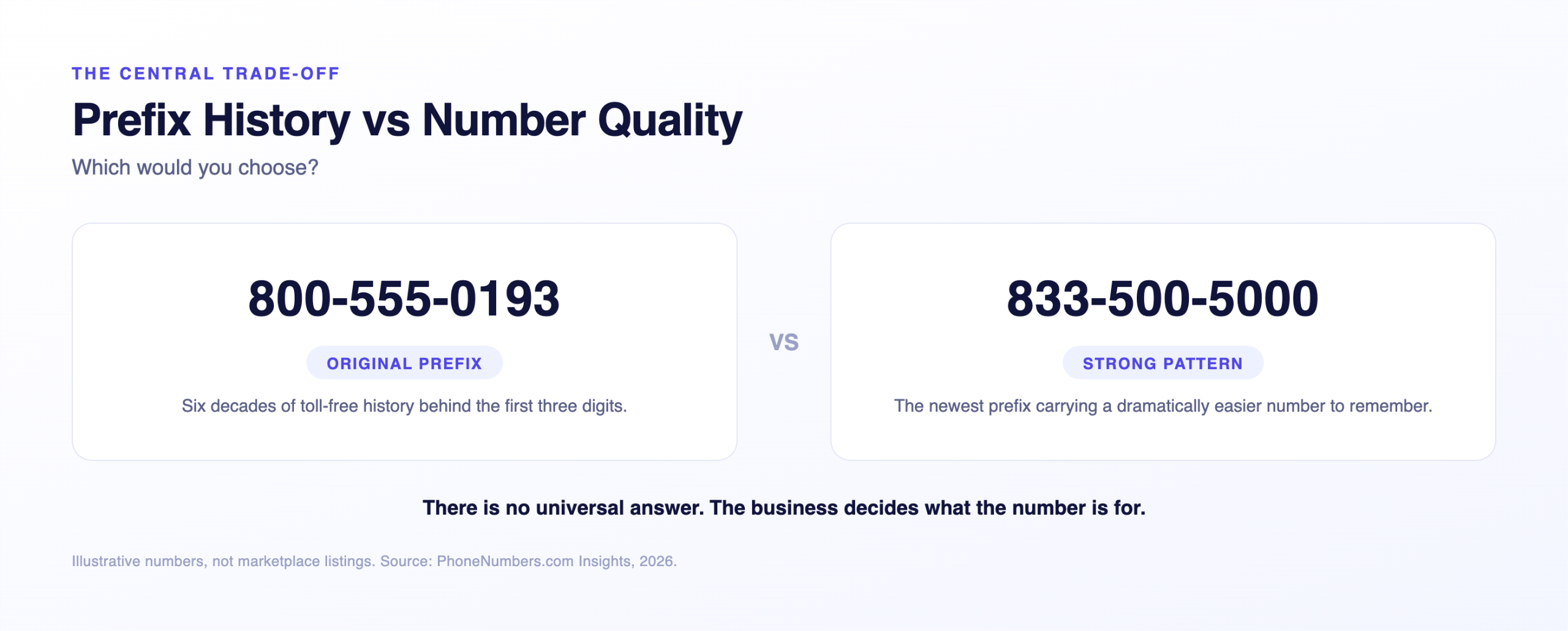
The opening of 888 also created an interesting dynamic: a business with a recognizable 800 number might want the corresponding digits in 888. Think of a pair like 800-555-5000 and 888-555-5000. The prefix changed; the recognizable seven-digit identity remained. The value of a toll-free number comes from the interaction between the prefix and the seven digits that follow it.
1998: 877
Two years later, 877 entered service in April 1998. By then, the toll-free system was becoming fundamentally different from the original one-prefix environment. Businesses now had three prefix families to consider, which created more availability but also more choice: prioritize the original 800 identity, or choose a better seven-digit combination in a newer prefix? That trade-off continues today.
2000: 866
The fourth toll-free code, 866, entered service in July 2000. By this point the pattern was clear: the toll-free numbering system would continue expanding when demand required additional resources. The newer prefixes were not created as lesser versions of 800. They were created as additional capacity within the same toll-free system. The network needed more numbers. New prefixes provided them.
2010: 855, After a Ten-Year Gap
After 866, roughly a decade passed before another prefix was required. 855 entered service in October 2010, into a communications environment that looked dramatically different from the one that produced the original 800 system: websites, mobile apps, email, search advertising, social media, VoIP and increasingly sophisticated call routing.
Yet toll-free numbering remained relevant. The communications channels changed. The value of having a persistent telephone identity did not disappear.
2013: 844
844 entered service in December 2013. As with previous openings, the objective was additional capacity. But by now another fact had become obvious: not all toll-free numbers are equally desirable. Businesses were interested in vanity words, repeaters, sequences, round numbers and easy-to-remember combinations. So opening a new prefix did more than create capacity. It created an entirely new pool of potentially memorable telephone identities.
2017: 833
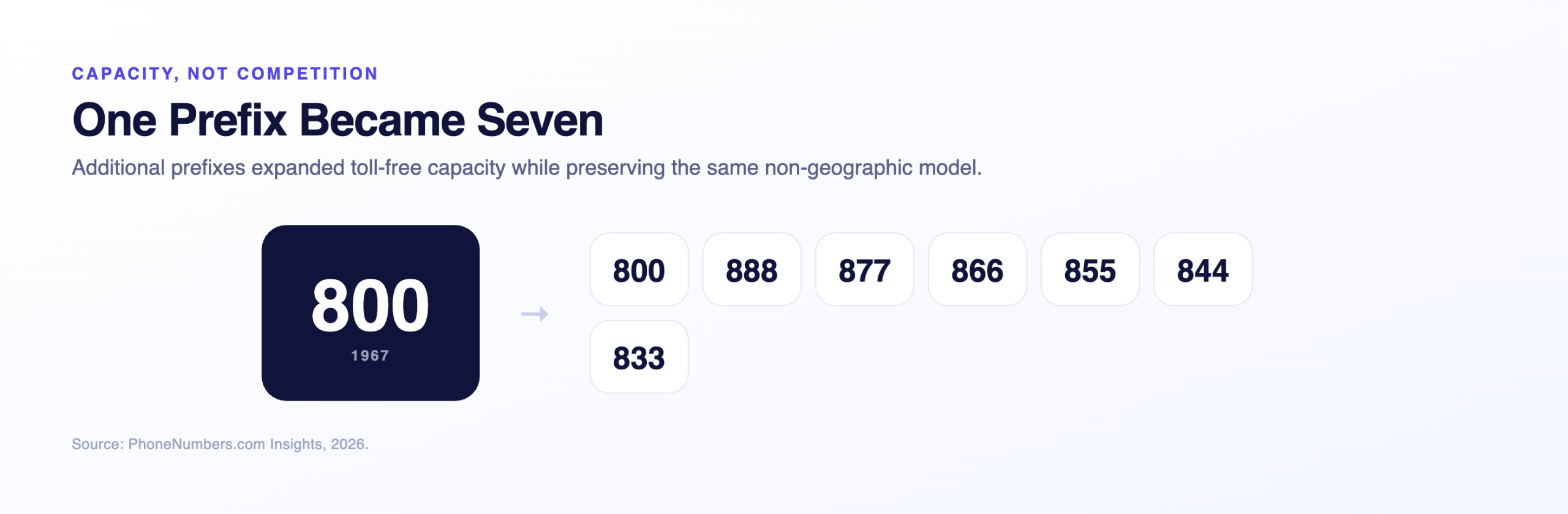
The newest active toll-free prefix, 833, entered service in 2017. With it, the active family became 800, 888, 877, 866, 855, 844 and 833. And the evolution may not be finished: additional toll-free numbering resources exist for future expansion. The system was designed to grow.
Seven Prefixes. One Toll-Free System.
Today, the seven prefixes differ in age, in how long consumers have encountered them, and in availability. But they are all part of the same toll-free numbering ecosystem.
| Prefix | In service since | History |
|---|---|---|
| 800 | 1967 | Original |
| 888 | 1996 | First expansion |
| 877 | 1998 | Early expansion |
| 866 | 2000 | Early expansion |
| 855 | 2010 | Later expansion |
| 844 | 2013 | Later expansion |
| 833 | 2017 | Newest active prefix |
That creates an important distinction between technical function and market identity. Technically, all are toll-free. From a branding and marketplace perspective, the individual prefix can still influence how a number is perceived.
800 Has Something the Others Cannot Replicate: History
No later toll-free prefix can become the original toll-free code. That position belongs to 800, with decades of accumulated familiarity: businesses advertised 800 numbers long before the commercial web, smartphones, search engines, social media or cloud communications. That history is real. But history should not be confused with universal superiority.
An ordinary 800 number and a strongly patterned 888 number are not comparable assets simply because one carries the older prefix. Which is the better business number? There is no universal answer. The business has to decide whether it values prefix identity or complete-number memorability more.
The Complete Number Became More Important as Prefixes Expanded
When 800 was the only toll-free prefix, businesses choosing toll-free had one major prefix decision: 800 or nothing. Today they have seven prefix families, which increases the chance of finding a strong vanity word, a repeating pattern, a round number or a preferred sequence.
This creates an important marketplace effect: a business can trade some prefix history for better number quality. A number in the newest active prefix that is dramatically easier to remember can be the more useful business asset than an ordinary number in the original code.
Toll-Free Evolution Increased Vanity Opportunities
Adding more prefixes did not simply create more random numbers. It created new opportunities to reproduce words and patterns. If the desired seven-digit vanity sequence is unavailable in 800, the same underlying sequence may exist in 888, 877, 866, 855, 844 or 833. That dramatically expands the pool of meaningful business numbers.
This matters because vanity value often comes from the word, not merely the prefix. The prefix provides the toll-free identity. The word provides the message.
Numeric Patterns Benefited Too
The same applies to premium numeric numbers. A buyer looking for a strong repeating number may find the desired pattern already taken within 800, but another prefix creates another set of possible combinations. The expansion of toll-free codes effectively multiplied the possible pool of repeaters, sequences, round numbers, mirrored structures and repeated blocks. For a marketplace, more prefixes create more potential premium combinations.
Read: The Anatomy of a Memorable Phone Number →
Toll-Free Portability Changed the Market Too
Another major change occurred in 1993, before the introduction of 888. Toll-free portability allowed subscribers to retain their toll-free number when changing service providers. This was strategically important: the relationship between the telephone number and the underlying service provider became less restrictive. The number could persist even as the infrastructure underneath it changed.
That helped strengthen the concept of the toll-free number as part of the subscriber’s communications identity rather than merely a feature attached to one carrier.
The Number Became More Persistent Than the Carrier
Businesses can change telephone providers, contact center platforms, routing systems, offices, employees and communications technology. Yet the toll-free number can remain. That gives a strong telephone number unusual longevity: a company might replace its entire communications stack while customers continue dialing the same number. The infrastructure changes. The identity persists.
What Is a RespOrg?
Toll-free numbers are administered differently from ordinary geographic numbers. A Responsible Organization, or RespOrg, manages toll-free records on behalf of a subscriber within the toll-free management system. That is part of the infrastructure most customers never see: a business sees its 800 number, and behind it exists a specialized management and routing ecosystem. The number is visible. The infrastructure behind it is data.
Toll-Free Numbers Are Non-Geographic
Unlike 212, 305 or 702, the toll-free prefixes do not identify a local geographic market. This creates a fundamental difference in business identity: a geographic number can communicate “we are in this market,” while a toll-free number can communicate “we are not defined by one market.” That is why toll-free numbers remain particularly relevant for companies operating nationally or across multiple locations.
Toll-Free Numbers in the Internet Era
It is reasonable to ask whether any of this still matters when people can click a phone number on a website. Sometimes less than it once did: a customer clicking a phone icon does not need to memorize the number. But businesses still use phone numbers in environments where memory matters: radio, television, outdoor advertising, vehicles, direct mail, word-of-mouth referrals, customer service and sales.
Numbers also persist inside CRM systems, advertising platforms, call routing infrastructure, customer accounts and business databases. So the role has evolved. The phone number is no longer simply something consumers memorize. It is also a persistent communications identifier across systems.
Tracking and Attribution Added Another Layer
Businesses can use multiple toll-free numbers to distinguish marketing channels or campaigns: one campaign uses one number, another uses a different number, and inbound calls provide another signal about where customer response originated. This transforms toll-free numbers from communications endpoints into measurement infrastructure. The number remains simple on the surface. Its business role becomes more sophisticated underneath.
From Toll-Free Number to Toll-Free Intelligence
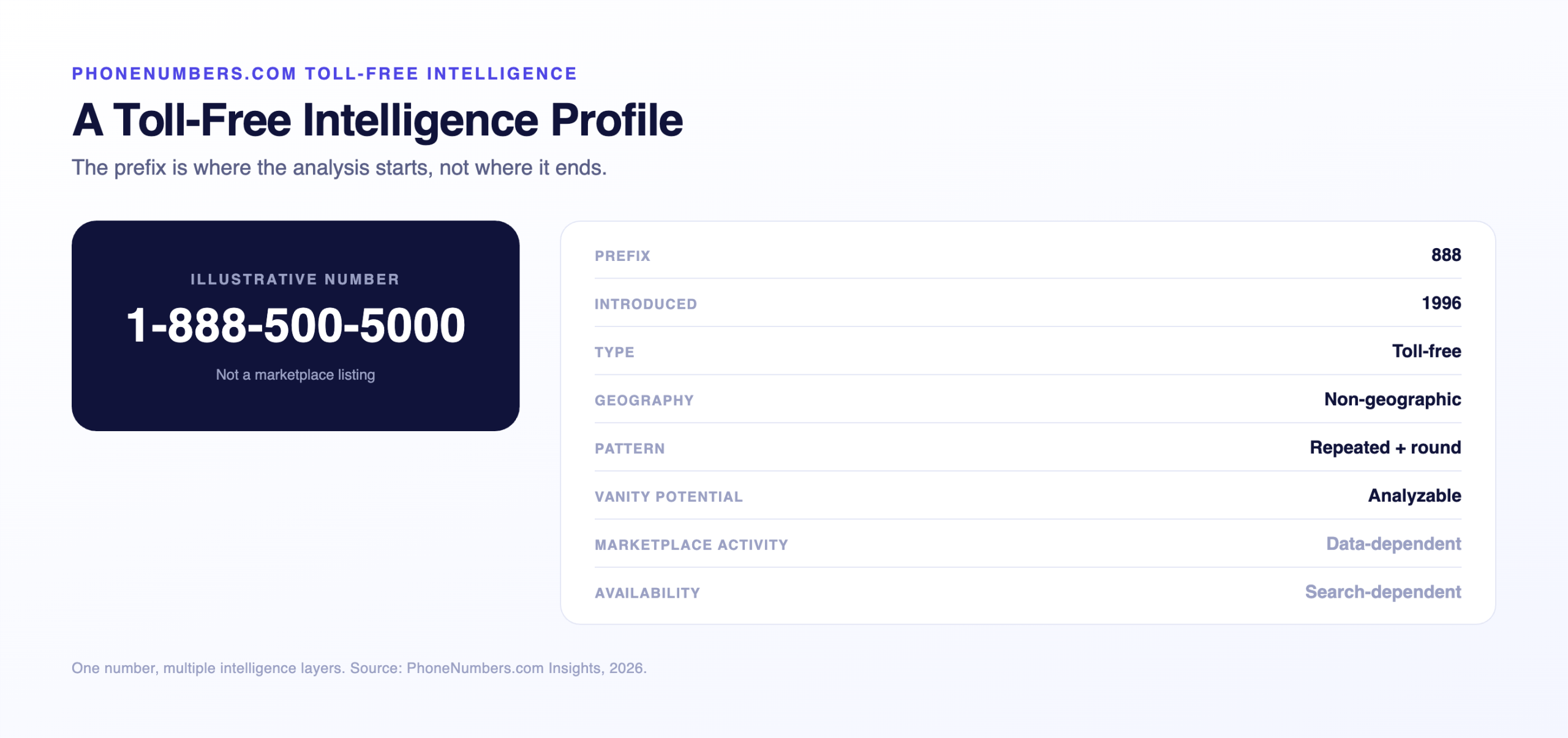
Today, a toll-free number can be understood across multiple layers: the prefix and its history, the number structure (repeater, sequence, vanity, round), availability of comparable numbers, RespOrg relationships, routing configuration, marketplace behavior around comparable numbers, and the business use it serves. This is Toll-Free Intelligence. The prefix is merely where the analysis starts.
Does Prefix Age Affect Demand?
This is where PhoneNumbers.com has an interesting research opportunity. We know when each toll-free prefix entered service, and we know the prefixes have different histories. What we should not do is assume how buyers value those differences.
Instead, marketplace data can potentially answer which prefixes are purchased most frequently, how that has changed over time, whether comparable 800 numbers command different prices from 888, how vanity demand varies by prefix, and which industries prefer toll-free numbers. These are empirical questions, and PhoneNumbers.com’s historical marketplace data can potentially help answer them.
The 800 Premium Is a Hypothesis Worth Testing
A common assumption is that 800 is worth more because it is the original toll-free prefix. That may be true in some parts of the market. But a serious intelligence platform should not turn conventional wisdom into fact. We would want to compare like with like: the same seven-digit pattern across 800 and 888, examined through purchase behavior, pricing, availability and historical movement. Only then can we begin discussing a measurable prefix premium.
Until then: 800 has the longest history. That is fact. Every 800 number is worth more than every 888 number. That is not.
The Evolution Is Not Over
The toll-free system was designed with room for additional expansion. 822 is reserved for future toll-free use. That does not mean we know when it will enter service, but it demonstrates that 833 may not remain the newest active prefix forever. And when another code enters service, the same cycle begins again: new availability, new vanity opportunities, new premium patterns, new marketplace behavior and, eventually, new history. 888 was once new. Now it has been in service for three decades. Time changes telephone identity.
From 800 to 833
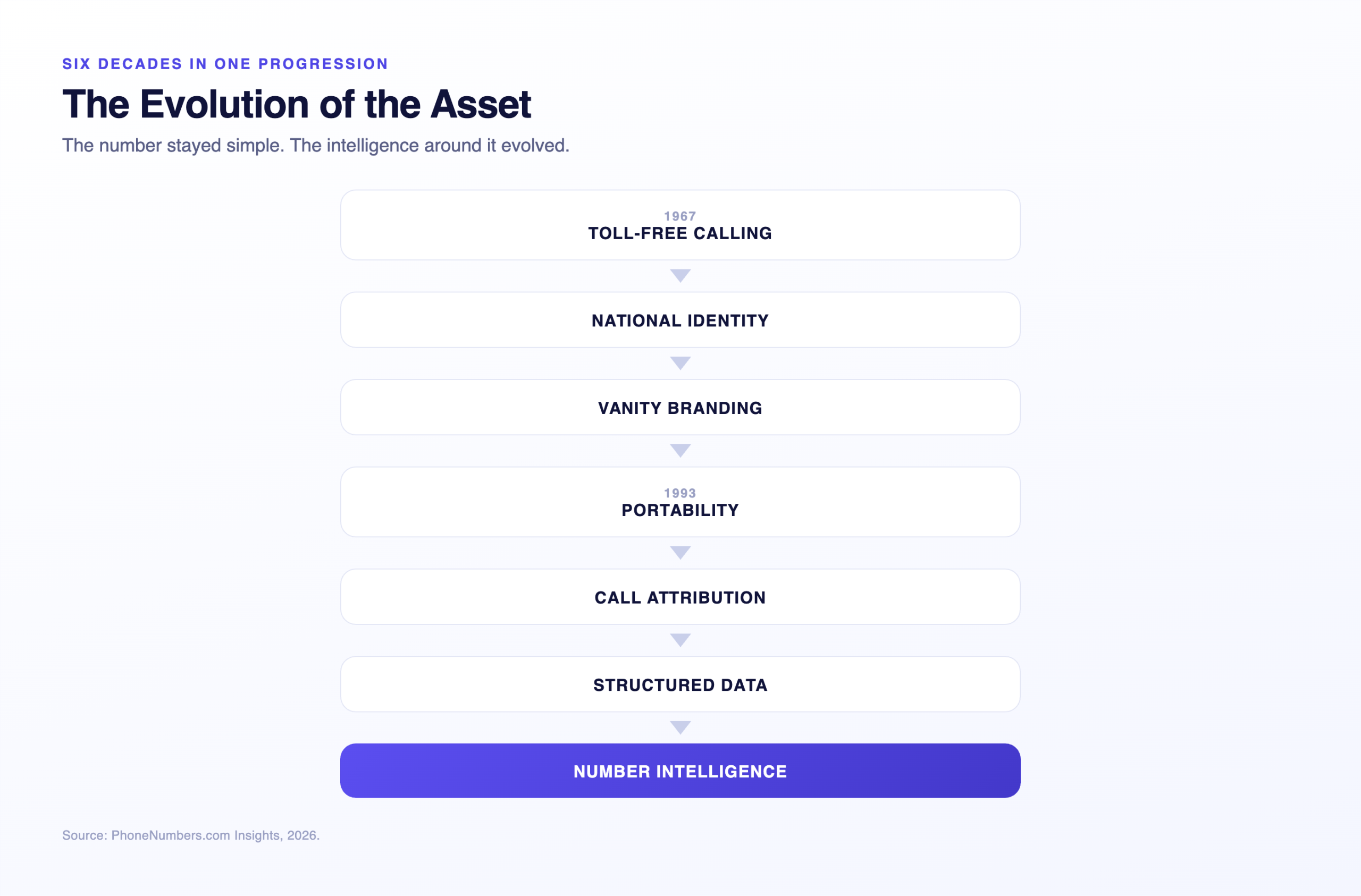
The evolution of toll-free numbers can be summarized in one progression. 800 solved a communications problem. Additional prefixes solved a capacity problem. Vanity numbers transformed numbers into brands. Portability made numbers more persistent. Modern communications made them programmable. Marketplace data made them measurable. And Number Intelligence can make them understandable.
What began as a way to remove long-distance charges for callers evolved into an ecosystem of communications identifiers used for branding, routing, advertising, customer service, sales, analytics and enterprise communications. Seven active prefixes. Millions of possible numbers. One continuing evolution.
Frequently Asked Questions
When was the first 800 number introduced?
Toll-free 800 service was introduced in 1967.
When was 888 introduced?
The 888 toll-free prefix entered service in March 1996.
When was 877 introduced?
877 entered service in April 1998.
When was 866 introduced?
866 entered service in July 2000.
When was 855 introduced?
855 entered service in October 2010.
When was 844 introduced?
844 entered service in December 2013.
When was 833 introduced?
833 entered service in 2017 and is currently the newest active toll-free prefix.
What are the current toll-free prefixes?
The current in-service toll-free prefixes are 800, 833, 844, 855, 866, 877 and 888.
Are all toll-free prefixes functionally the same?
They are all part of the toll-free numbering system. They differ in history, availability and potentially marketplace perception, but they do not represent different geographic service areas.
Why were more toll-free prefixes created?
Additional prefixes were introduced as demand consumed available numbering resources within existing toll-free codes.
Can you keep a toll-free number when changing providers?
Toll-free portability allows a subscriber to retain a toll-free number when changing service providers, subject to the applicable toll-free system and processes.
What is a RespOrg?
A Responsible Organization manages toll-free number records for subscribers within the toll-free management system.
Will there be more toll-free prefixes?
Additional toll-free numbering resources are reserved for future use, including 822, but that does not establish when a new prefix will be placed into service.
About PhoneNumbers.com Toll-Free Intelligence
The toll-free system has evolved for nearly six decades. Its prefixes tell part of that story. Its numbers tell another. PhoneNumbers.com Toll-Free Intelligence is being developed to bring together numbering history, prefix information, number patterns, marketplace signals and telecommunications context to help businesses better understand the toll-free numbers they use and acquire.
Because 800, 888 and 833 are more than three different prefixes. They are different chapters in the evolution of a communications asset.
Explore Toll-Free Intelligence → Read: 800 vs 888 vs 877 → Explore Number Intelligence →
Search Available Toll-Free Numbers →
More from PhoneNumbers Insights
Area codes
- America’s Most In-Demand Area Codes of 2026
- 212 vs 646 vs 917: Understanding New York’s Most Recognized Area Codes
- The Original Area Codes: Why Legacy Codes Still Matter
- The Intelligence Behind an Area Code
Toll-free numbers
- 800 vs 888 vs 877: Which Toll-Free Prefix Is Best?
- Local vs Toll-Free Numbers: Which Is Right for Your Business?
Choosing & buying a number
- How to Choose a Business Phone Number
- How to Get a Vanity Phone Number for Your Business
- What Makes a Phone Number Valuable?
- The Anatomy of a Memorable Phone Number