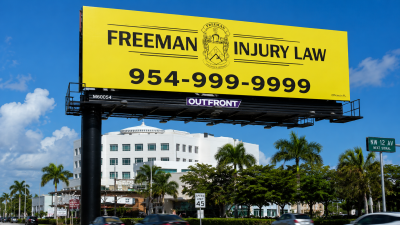
At first glance, a phone number looks like a simple identifier: a three-digit area code followed by a seven-digit local number. But the digits are only the beginning. Depending on the data available, a phone number can provide context about its country and numbering plan, its area code and related overlays, its carrier, line type and portability, its assignment history, its digit patterns and its marketplace characteristics.
Some of those are numbering facts. Some are current network attributes. Some are marketplace observations. And some require interpretation. That distinction matters: phone number intelligence is not about guessing what a number means. It is about understanding what reliable data can, and cannot, tell us about the number itself.
Start With the Number
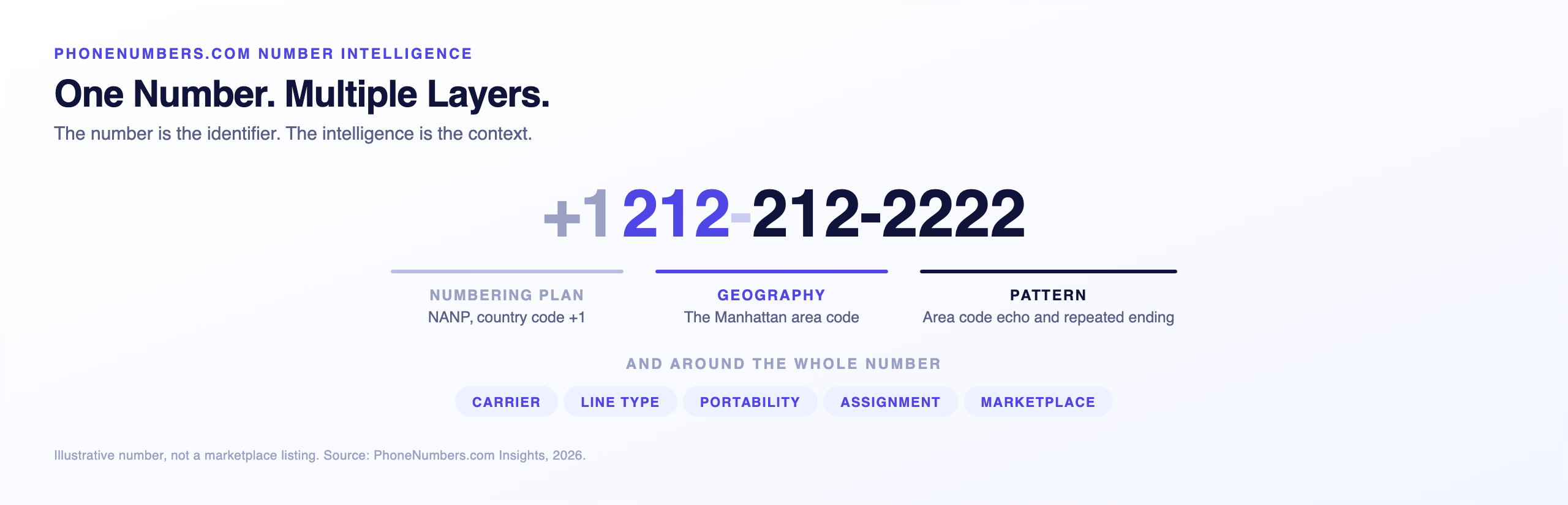
Consider a hypothetical number: +1 212-212-2222. To most people, it is simply a telephone number. But it can be broken into multiple layers. The +1 tells us which international numbering environment we are entering. The 212 provides area code context. The 212-2222 echoes the area code and ends in four identical digits. External telecommunications data may add carrier and line type information. Historical data may add numbering context. Marketplace data may tell us something about demand around the area code.
The number has not changed. Our understanding of it has.
1. What Numbering System Does It Belong To?
The first layer is the numbering plan. The United States participates in the North American Numbering Plan, along with Canada and a number of other countries and territories. NANP numbers use country code +1 followed by a ten-digit national number. Understanding the numbering plan matters because the digits need context before they can be interpreted correctly. A Number Intelligence system should not begin by guessing what the number represents. It should begin by understanding its structure.
2. What Does the Area Code Tell You?
For US geographic numbers, the area code provides one of the most recognizable pieces of information: 212 for Manhattan, 305 for Miami, 702 for Las Vegas, 202 for Washington, DC. That makes the area code a useful geographic signal. But there is an important limitation: an area code identifies numbering geography. It does not prove where the person or business using the number is physically located today. Someone can move and keep a number, a company can route calls anywhere, and mobile and VoIP services make geography even less restrictive.
So: area code equals geographic context, not real-time location.
Read: The Intelligence Behind an Area Code →
3. What Other Area Codes Serve the Same Market?
One area code does not always equal one geography. Many markets now operate with overlays, where multiple area codes serve substantially the same region. A Manhattan business might use 212, 332, 646 or 917: the geography may overlap, but the histories do not.
Knowing that relationship adds another intelligence layer. A useful area code profile can tell us which codes serve the same market, which came first, when newer codes were introduced, whether the region was split or overlaid, and how marketplace demand differs among those codes. We are no longer simply asking where 212 is. We are asking how 212 fits into the numbering environment around it.
4. Can a Phone Number Tell You Its Carrier?
Potentially, but this is where the underlying data becomes important. Prefix information can provide context about where numbering resources originated. But number portability means a number can move from one provider to another, which creates an important distinction between original numbering assignment and current service provider. Those are not necessarily the same.
So a serious intelligence system should not look at an old prefix assignment and simply declare the carrier. Current carrier intelligence requires current carrier data.
5. Can You Tell Whether It Is Mobile, Landline or VoIP?
Depending on the telecommunications data available, a number may be associated with a line classification: wireless, landline, VoIP or another service category. That can be useful for businesses: a communications platform may need to understand the type of endpoint, a CRM may want context around a customer record, and a data platform may want to enrich millions of records.
But this information is not permanently encoded into the digits. Networks change, numbers move, services evolve. Line type is a data attribute, not a visual characteristic of the phone number.
6. Has the Number Been Ported?
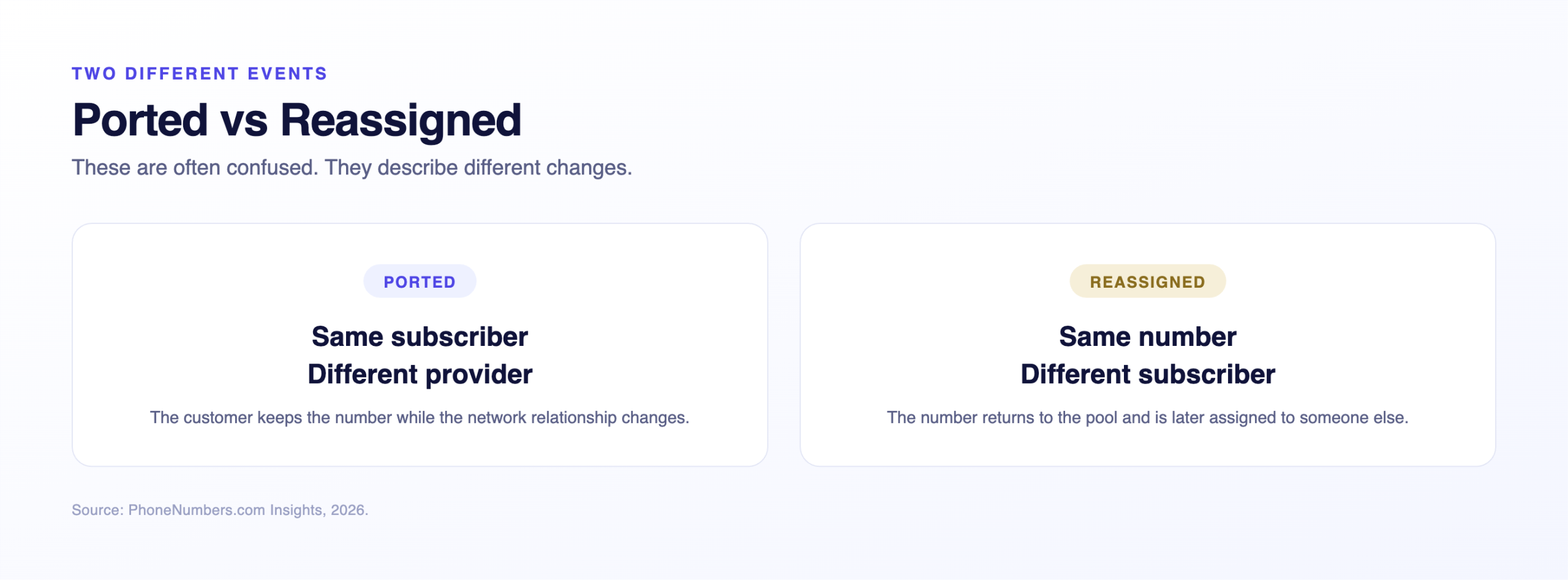
Portability creates another intelligence layer. A customer can retain a telephone number while moving it between compatible service providers, which means same number does not necessarily mean same carrier. This is why static carrier information can become stale. For B2B systems processing large volumes of telephone records, knowing whether the network relationship has changed can be significantly more useful than knowing the number’s original assignment.
7. Has the Number Been Reassigned?
Porting changes the provider. Reassignment changes the subscriber. That is a critical distinction. A subscriber disconnects a number; eventually, that number may become available for assignment again, and another subscriber receives it. The digits remain identical. The person or business associated with them has changed. This is one reason phone numbers should not automatically be treated as permanent identity keys.
8. Has the Number Ever Been Assigned?
That is a different question again. A number that is new to the customer is not necessarily a number that has never been assigned before. Numbers throughout the telecommunications ecosystem can be disconnected and later reassigned. For businesses selecting a telephone identity they may use for years, assignment history can therefore matter.
Numbers offered through the PhoneNumbers.com marketplace are new numbers that have never previously been assigned to an end user. That allows the business to establish the first subscriber identity associated with the number rather than inheriting a prior subscriber history. This is especially relevant when the number itself will become part of the company’s brand.
Read: Why Your New Phone Number May Have a History →
9. Can a Phone Number Have a Reputation?
Potentially. Telephone numbers can accumulate signals in external systems relating to reported spam, calling behavior, caller ID databases, previous business associations and historical records. But reputation data requires careful interpretation: a number can be reassigned, a database can be stale, a classification can be wrong, and a historical association may no longer describe the current subscriber.
So number reputation should be treated as a signal, not proof of current identity or intent. A useful intelligence platform should show enough context for a business to understand the difference.
10. Can a Phone Number Tell You Who Owns It?
Not from the digits themselves. Reverse phone data may associate a number with records from various sources, but that information should not automatically be assumed to be current, complete or correct. Numbers can be shared, ported, reassigned, used by businesses or software platforms, and associated with different records over time.
So the better question is: what current and historical identity signals are associated with this number? That is more defensible than pretending every number has one permanent identity attached to it.
11. Can a Phone Number Tell You Where Someone Is Right Now?
No. Not from the number alone. A Manhattan area code does not establish that someone is currently in Manhattan. The number may have originated there, the subscriber may have moved, the number may be routed through a cloud platform, and the caller may be on the other side of the country.
Numbering geography is not physical location. Area Code Intelligence describes the geographic identity associated with a number. It should not pretend to be real-time location intelligence.
12. What Can the Digits Tell You About the Number Itself?
Not all Number Intelligence requires external telecommunications data. Some information is contained directly in the structure of the digits: obvious repetition in a number ending XXX-777-7777, a strong round structure in XXX-500-0000, a sequence in XXX-234-5678, repeated blocks in XXX-212-1212.
Software can identify repeating digits, repeated blocks, sequences, reverse sequences, symmetry, alternating digits, round endings and vanity possibilities. This creates another intelligence layer: pattern intelligence.
Read: The Anatomy of a Memorable Phone Number →
13. Can You Measure Memorability?
We can measure characteristics associated with memorability. That is different from pretending we can perfectly measure human memory. Attributes such as repeating digits, longest repetition, sequence detection, round endings, repeated blocks, vanity matches and pattern coverage are explainable.
What we should avoid is inventing something like a memorability score of 97 out of 100 unless the methodology behind that score has actually been developed and validated. The goal of Number Intelligence should not be to create impressive looking numbers. It should be to expose the signals behind the conclusion.
14. What Does the Area Code Tell Us About Marketplace Demand?
This is where PhoneNumbers.com has something different from a conventional phone number database. Marketplace activity provides another layer of intelligence. Our 2026 marketplace research found several area codes with particularly strong relative purchase activity: 516 at No. 1, 212 at No. 2, 747 at No. 3, 929 at No. 4 and 305 at No. 5.
We do not need to disclose exact transaction volumes for that to be useful. The rankings allow us to understand relative marketplace activity while protecting proprietary sales data. That gives us two views of an area code: the numbering data (212 is associated with Manhattan) and the marketplace data (212 ranked No. 2 in relative purchase activity). Put them together and the area code becomes much more interesting.
15. What Can Historical Marketplace Data Tell Us?
A single year provides a snapshot. Multiple years provide a trend. An area code climbing through the rankings tells a different story from one sliding down them, and the current ranking alone hides the difference. PhoneNumbers.com is developing historical marketplace analysis extending back to 2013, which can eventually allow users to explore ranking movement, regional trends, legacy versus overlay performance and rising or declining area codes, without publishing the underlying proprietary transaction counts. This is where sales history starts becoming Market Intelligence.
16. Can a Phone Number Tell You What It Is Worth?
Not by itself. A number can contain characteristics that may influence marketplace value: area code, pattern, memorability, scarcity, vanity potential, marketplace demand and availability. But no single characteristic establishes what every buyer will pay. An ordinary number in a legacy area code and a strongly repeating number in a newer overlay may appeal to different buyers, and a number combining both signals at once is where scarcity becomes particularly significant.
The better approach is not to declare that a number is worth exactly some amount. It is to ask what signals might influence how the market values it.
Read: What Makes a Phone Number Valuable? →
17. Can You Tell Whether a Number Is Available?
Availability is another intelligence layer. A number can be assigned, reserved, unavailable, or available through a marketplace or provider, and availability changes. This is where intelligence connects directly to action: a user should not have to stop at knowing that 212 is associated with Manhattan. They should be able to continue to available 212 numbers, and eventually to available 212 numbers with strong repeating patterns. That is the bridge between Area Code Intelligence, Number Intelligence and the marketplace.
18. What Can You Learn From a Toll-Free Number?
Toll-free numbers have their own intelligence layers. The prefix identifies the toll-free family (800, 888, 877, 866, 855, 844, 833), and unlike geographic area codes, these prefixes are non-geographic. Then we can examine prefix history, pattern, vanity potential, availability, RespOrg context, marketplace activity and business use. That creates another specialized category: Toll-Free Intelligence.
Read: The Evolution of Toll-Free Numbers →
19. What Can a Phone Number Tell a Business?
For B2B users, the real opportunity is not one lookup. It is scale. A company may have a hundred numbers, a hundred thousand, or millions inside its systems. At that point, Number Intelligence can support data enrichment (adding structured telecommunications context to existing records), CRM intelligence, communications routing, marketplace classification, portfolio analysis of large collections of numbers, market research on aggregate demand, and AI applications that receive verified structured context rather than being asked to guess.
This is where Number Intelligence moves beyond consumer lookup.
20. The Number Intelligence Stack
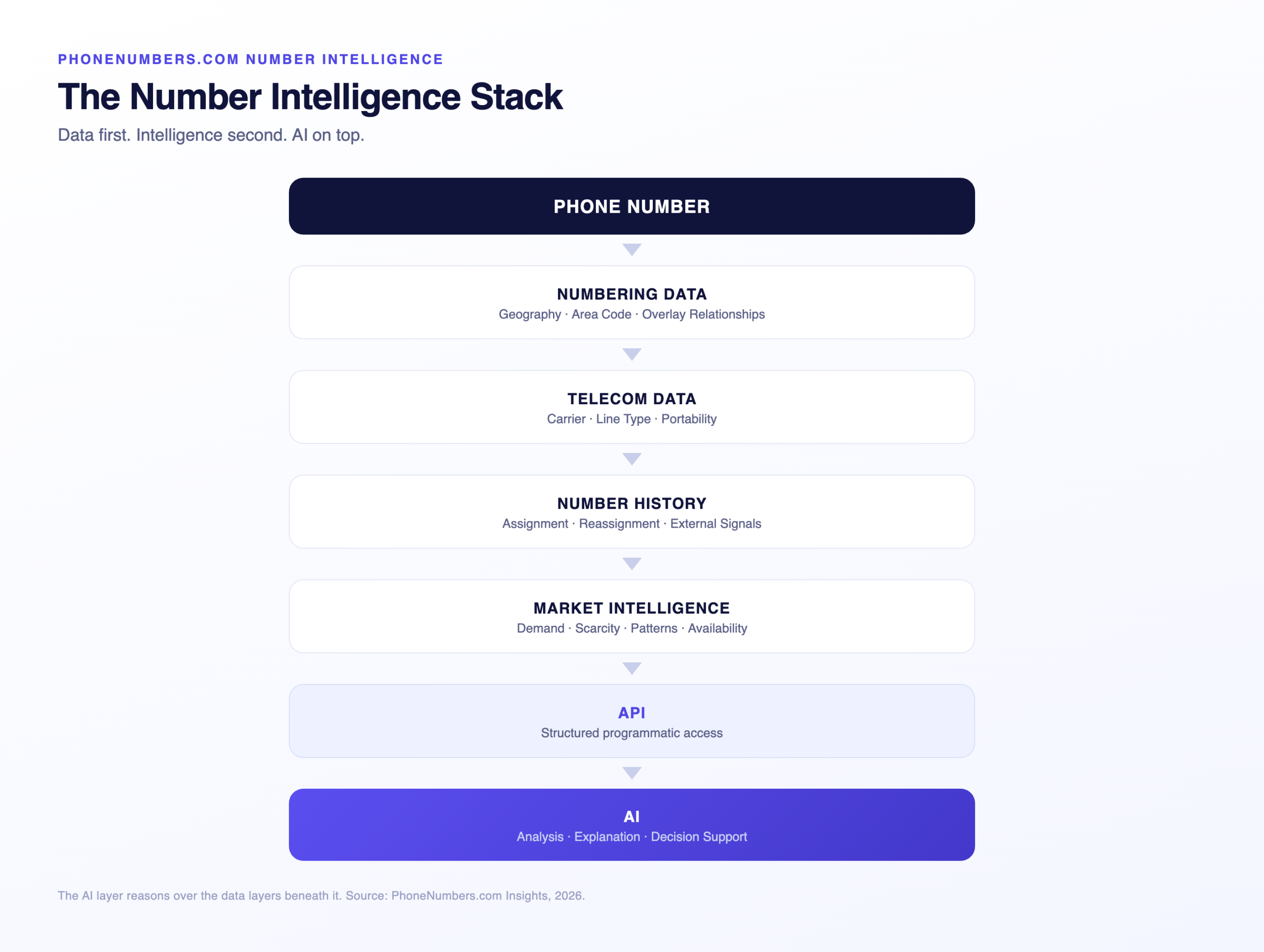
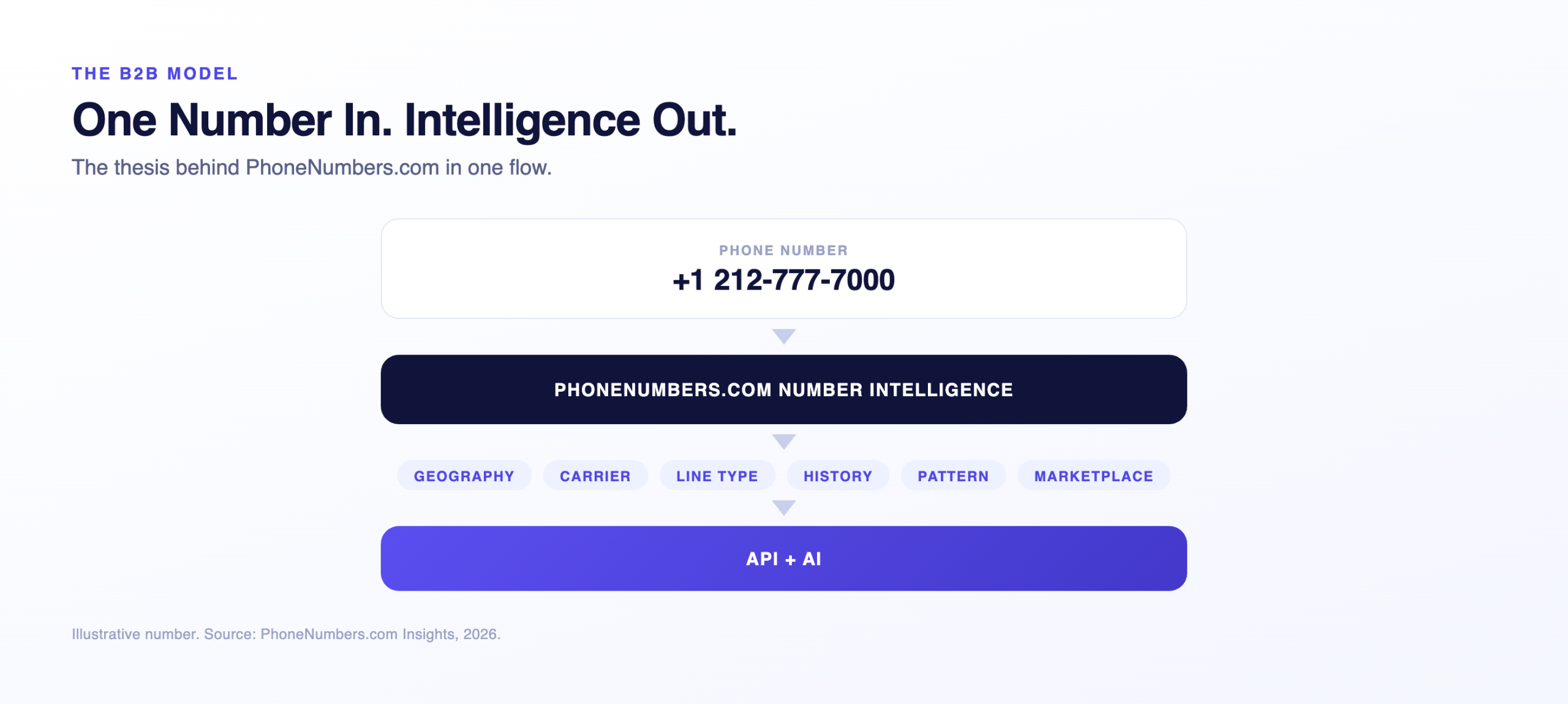
A useful way to think about a phone number is as layers: the numbering facts, the geography, the telecom attributes, the history, the number characteristics, the market intelligence, and then the API and AI layers on top. The visible telephone number stays the same. The intelligence around it becomes richer.
Data Is Not the Same as Intelligence
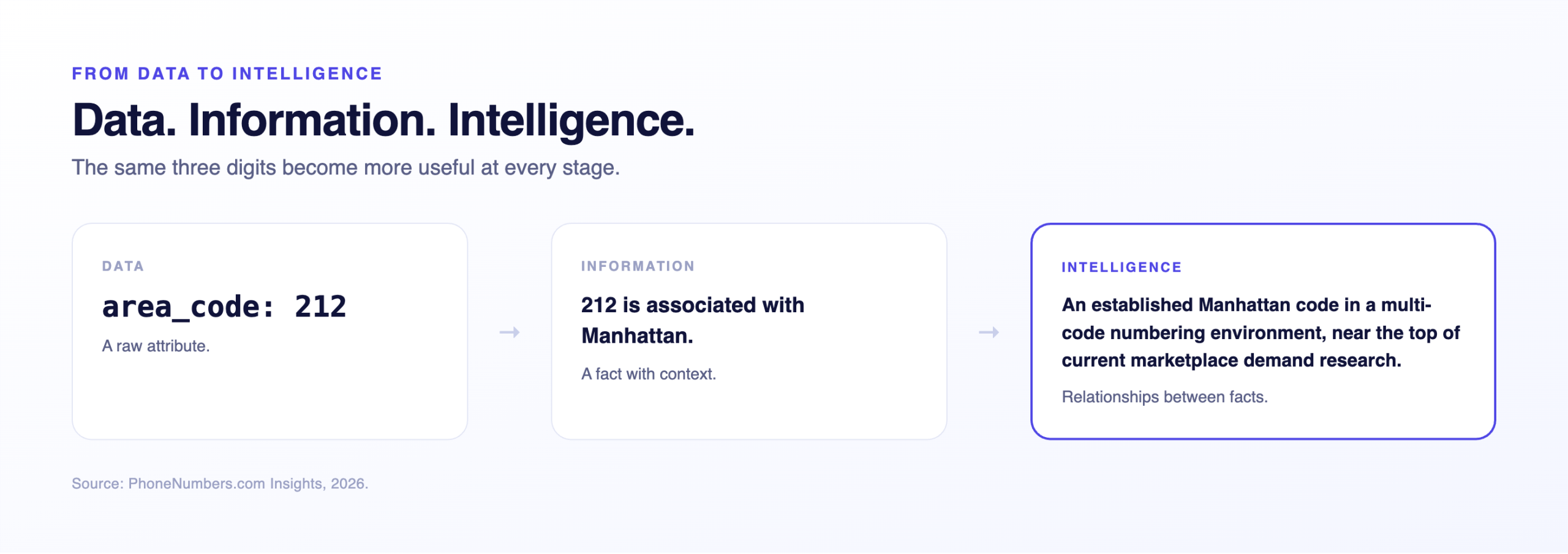
Consider the progression. Data: the area code is 212. Useful. Information: 212 is associated with Manhattan. More useful. Intelligence: 212 is an original 1947 area code associated with Manhattan, exists within a multi-code numbering environment and ranked No. 2 in PhoneNumbers.com’s 2026 marketplace analysis by relative purchase activity. That is different. Data provides attributes. Intelligence connects those attributes and provides context.
Intelligence Is Not the Same as AI
This distinction is increasingly important. An AI model can explain data, summarize it, compare numbers, help users search and answer natural language questions. But the AI should not be the source of the underlying telecommunications facts. The data should be. The architecture should be authoritative data, then structured intelligence, then AI. Not AI producing guesses. That is a fundamental principle behind the way PhoneNumbers.com approaches Number Intelligence.
What Could a Number Intelligence API Look Like?
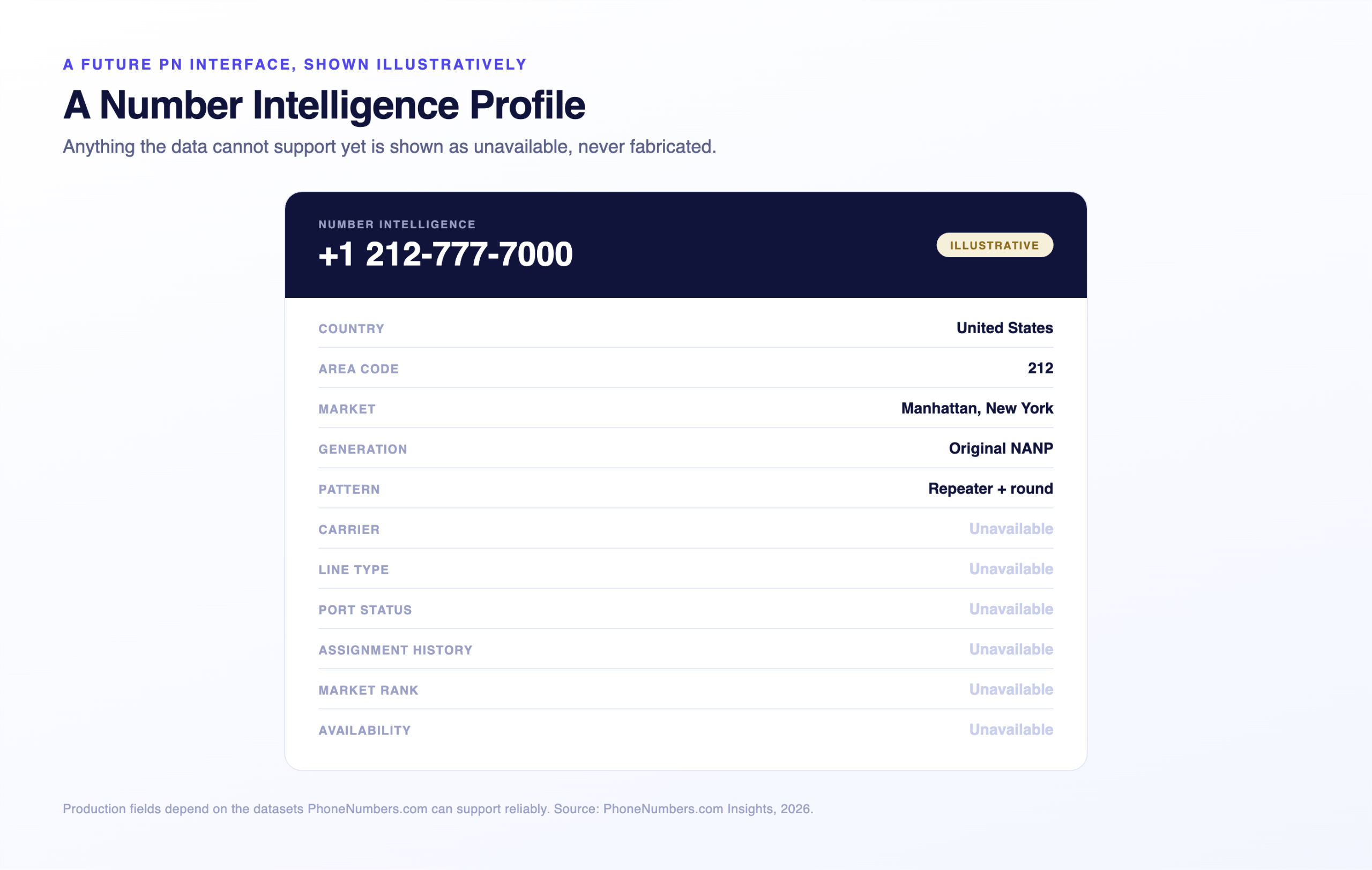
Imagine a business submits a number and receives structured intelligence:
number:          +1 212 212 2222
country:         United States (+1, NANP)
area_code:       212
market:          Manhattan, New York
generation:      Original NANP
overlays:        [data-dependent]
carrier:         [data-dependent]
line_type:       [data-dependent]
portability:     [data-dependent]
assignment:      [data-dependent]
pattern:         Repeater + round
market_rank:     [data-dependent]
availability:    [data-dependent]
last_verified:   [timestamp]
The actual production fields should depend entirely on the datasets PhoneNumbers.com can support reliably. But the concept is simple: one number in, structured intelligence out. That is considerably more useful to a B2B system than another page that simply tells someone where an area code is located.
What Could AI Do With That Intelligence?
Once reliable structured data exists underneath it, an AI layer becomes much more interesting. A user could ask: tell me what matters about this number. Compare these two numbers. Find the strongest numbers in this portfolio. Which area codes here are overlays? Show me memorable Manhattan numbers. Find toll-free numbers that could work for a home services company.
The AI does not need to invent the answer. It interprets the request and queries the intelligence underneath it. That is the model: data, then intelligence, then AI.
What You Should Not Infer From a Phone Number
Understanding a number also means understanding its limitations. A phone number alone does not reliably prove who currently owns it, where that person currently is, whether a caller is trustworthy, why someone is calling, whether an old database record is still accurate, whether a reputation label is correct, or what the number is worth. Those conclusions require additional evidence.
Never make the data claim more than it actually knows.
Look Beyond the Digits
A phone number can be an identifier, a geographic signal, a network endpoint, a portable resource, a reassigned resource, a business identity, a memorable pattern, a marketplace asset and a key inside a much larger dataset. All from the same digits.
That is why the most interesting question is not what this phone number is. It is what we can responsibly learn from it. The answer depends on the data available. And that is the foundation of Number Intelligence. The digits are where the story starts.
Frequently Asked Questions
What information can you get from a phone number?
Depending on the available data, a phone number can provide context about its country, numbering plan, area code, geographic association, carrier, line type, portability, assignment history, number pattern and marketplace characteristics.
Can you tell where someone is from a phone number?
An area code can provide geographic numbering context, but it does not reliably establish where the person or business currently using the number is physically located.
Can you identify a carrier from a phone number?
Current carrier information may be available through telecommunications data. The number’s original prefix assignment should not automatically be assumed to identify its current carrier because numbers can be ported.
Can you tell if a phone number is mobile, landline or VoIP?
Depending on the underlying dataset, line type information may classify numbers as wireless, landline, VoIP or another service type.
Can you tell whether a phone number has been reassigned?
Reassignment related data can provide information about whether a number has changed subscribers, depending on the dataset and use case.
Can a phone number tell you someone’s exact location?
No. The number alone does not provide reliable real-time physical location.
Can a phone number tell you who owns it?
Not inherently. Identity information may be associated with external records, but those records can be incomplete, outdated or affected by reassignment.
Can you tell whether a phone number is valuable?
Area code, pattern, memorability, scarcity, availability and marketplace demand can provide valuation signals, but they do not establish one universally correct price.
What is phone number intelligence?
Phone number intelligence is structured context around a telephone number, combining reliable numbering, telecommunications, historical, pattern and marketplace data.
What is the difference between phone number intelligence and reverse lookup?
Reverse lookup primarily asks who or what may be associated with this number. Number Intelligence asks a broader question: what can we know about the number itself? That can include geography, carrier, line type, portability, numbering history, patterns and marketplace signals.
About PhoneNumbers.com Number Intelligence
PhoneNumbers.com is building around a simple idea: a phone number is more than ten digits. The number sits within a numbering plan. It can have geographic context. It interacts with carriers and networks. It can move. It can be reassigned. Its digits can contain patterns. Its area code can have marketplace history. And businesses may need access to those signals at scale.
PhoneNumbers.com Number Intelligence is being developed to bring those layers together in a structured way, across web experiences, market research and eventually programmatic and AI assisted applications. Because the future is not another database that simply stores telephone numbers. It is understanding the intelligence behind every number.
Explore Number Intelligence → Read: Look Beyond the Digits → Explore Area Code Intelligence → Explore Market Research →
More from PhoneNumbers Insights
Area codes
- America’s Most In-Demand Area Codes of 2026
- 212 vs 646 vs 917: Understanding New York’s Most Recognized Area Codes
- The Original Area Codes: Why Legacy Codes Still Matter
- The Intelligence Behind an Area Code
Toll-free numbers
- 800 vs 888 vs 877: Which Toll-Free Prefix Is Best?
- The Evolution of Toll-Free Numbers: From 800 to 833
- Local vs Toll-Free Numbers: Which Is Right for Your Business?
Choosing & buying a number
- How to Choose a Business Phone Number
- How to Get a Vanity Phone Number for Your Business
- What Makes a Phone Number Valuable?
- The Anatomy of a Memorable Phone Number