Two phone numbers can provide essentially the same telecommunications function and still have very different market appeal. Buyers are not necessarily purchasing only ten digits. They may be purchasing identity, memorability, geography, scarcity and utility, and sometimes several of those characteristics occur in the same number.
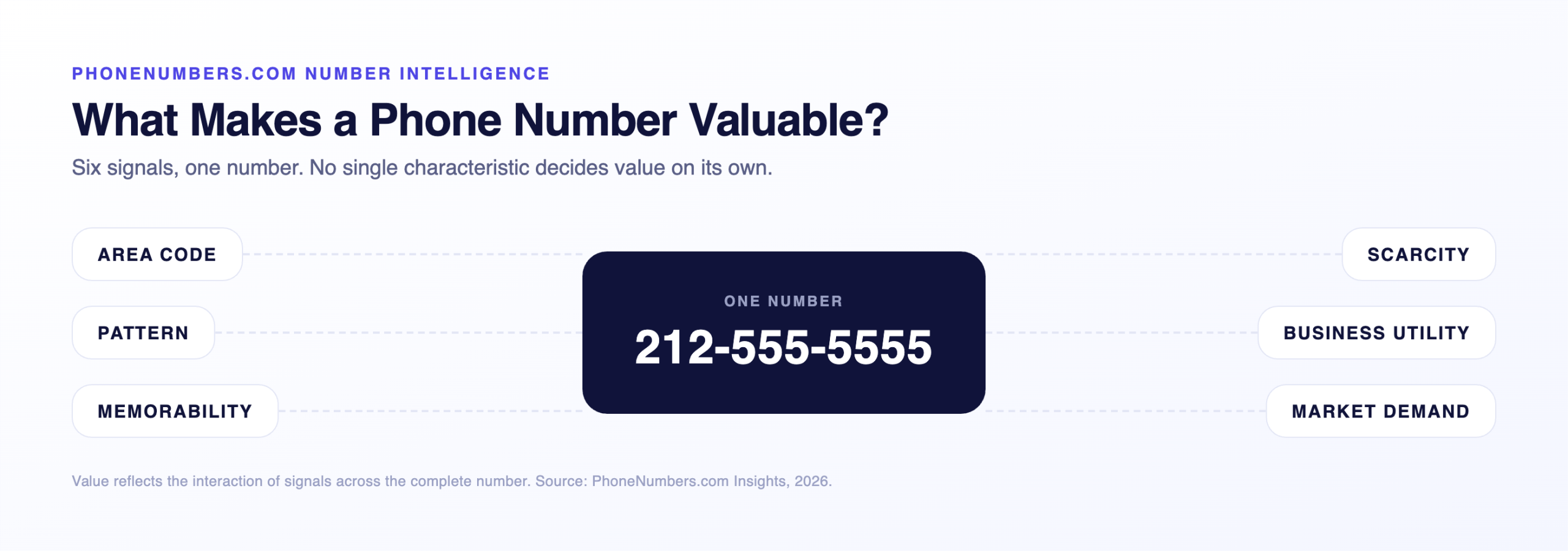
There is no single formula that determines what every phone number is worth. At PhoneNumbers.com, we think about number value as the interaction of six signals: area code, pattern, memorability, scarcity, business utility and market demand. Understanding those signals is more useful than asking whether any single characteristic is inherently valuable.
A Phone Number Is More Than Ten Digits
At the network level, a telephone number has a straightforward job: identify an endpoint within the numbering system. In the marketplace, things become more complicated.
Consider two illustrative numbers: 212-555-0147 and 212-555-5555. Both share the same area code, both contain ten digits, and both can perform the same fundamental function. Yet a buyer is unlikely to evaluate them identically. The second has an immediately recognizable repeating pattern. It can be spoken easily, remembered after limited exposure and reproduced with less effort.
Now change the area code and consider 646-555-5555. The memorable pattern remains, but the geographic signal changes. Which is more valuable? There is not enough information to answer that universally. A buyer prioritizing Manhattan’s established 212 identity might favor the first. Another buyer may care much more about the memorable pattern than the area code. Price, availability and intended use can change the decision again.
This illustrates one of the most important principles in phone number valuation:
The value of a phone number comes from the complete number, not any single characteristic in isolation.
Signal 1 · Area Code
The first three digits immediately provide context. For geographic numbers, an area code can communicate a market: 212 for Manhattan, 305 for Miami, 702 for Las Vegas, 202 for Washington, DC, 310 for Los Angeles.
Some area codes have existed for decades and developed strong associations with the markets they serve. Others are newer overlays serving substantially the same geography as an established code. That does not automatically make an older area code more valuable.
Our 2026 marketplace research demonstrates why. While established 212 ranked No. 2 in relative purchase activity, newer overlays also performed strongly: 747 ranked No. 3 and 929 ranked No. 4. So the data does not support a simple rule that old means valuable and new means less valuable. Area code identity is one signal among several.
Explore America’s Most In-Demand Area Codes →
Signal 2 · Memorability
A valuable business number often has one basic characteristic: people can remember it. That sounds obvious, but memorability can come from several different structures.
Compare 800-555-0147 with 800-555-5555. The second contains an obvious pattern. A caller does not need to memorize seven independent digits; the pattern does part of the cognitive work.
Memorability can come from repetition, sequences, symmetry, grouped digits, round numbers, recognizable words and familiar numeric associations. The more easily someone can hear, understand, remember and reproduce a number, the more useful that characteristic can become for businesses relying on telephone response.
But memorability alone does not establish market value. A memorable number still needs a buyer who values that particular structure.
Signal 3 · Number Patterns
Some phone numbers contain patterns that make them immediately distinctive. Examples include structures such as XXX-777-7777, XXX-500-0000, XXX-234-5678 and XXX-212-1212. These are fundamentally different from random digit strings.
At PhoneNumbers.com, number patterns are an important part of how we think about Number Intelligence. A number can be analyzed for characteristics such as repeating digits, sequences, mirrored structures, repeated blocks, round-number endings, alternating patterns and vanity possibilities.
That creates a more useful way to describe a number than simply saying it looks good. The pattern can be identified. The rarity of that pattern can eventually be measured. And marketplace behavior can help us understand whether buyers actually respond to it. That distinction, between subjective appearance and measurable characteristics, is central to how PhoneNumbers.com approaches number intelligence.
Signal 4 · Scarcity
Scarcity is one of the most misunderstood characteristics of premium phone numbers. Every individual telephone number is technically unique. That does not make every number scarce in an economically meaningful sense. What matters is the scarcity of the characteristics buyers care about.
There may be many available numbers in a particular area code. There may be far fewer with six or seven repeating digits, highly structured patterns, desirable vanity words, particular memorable endings, or a specific area code combined with a specific pattern.
Consider a hypothetical buyer looking for a 212 number. If the only requirement is any available 212 number, the potential selection may be very different from someone requiring a 212 number with an exceptionally memorable repeating pattern. The second requirement dramatically narrows the field. So scarcity should not be evaluated only at the area code level. It can exist at the complete-number level.
Signal 5 · Business Utility
This may be the most important factor of all. A phone number can have characteristics that create real utility for a particular business.
Consider a hypothetical plumbing company choosing between 305-555-0142 and 305-PLUMBER. The second number communicates something before the customer even calls. For another business, a numeric repeater might be more useful because it is easy to say on radio, display on a vehicle or remember from an advertisement.
This is why value is partly buyer-specific. The same number can have different economic utility to a law firm, a home services company, a national advertiser, a medical practice, a financial services company or an individual consumer. A strong phone number can function as part of a company’s identity. And when the number itself contributes to recognition or response, its value may extend beyond basic telecommunications service.
Signal 6 · Market Demand
Ultimately, characteristics become commercially important when buyers actually care about them. That is why marketplace data matters. It is possible to construct theories about which area codes, patterns or vanity terms should be desirable. Transaction behavior provides another signal: what are buyers actually choosing?
PhoneNumbers.com analyzes marketplace activity to understand those choices. Our research can examine which area codes appear most frequently in purchases, whether established codes behave differently from overlays, which number patterns attract buyer activity, how demand changes over time, and whether particular characteristics correlate with marketplace behavior.
This is where marketplace data and Number Intelligence begin to intersect. A number’s characteristics can be identified. Marketplace behavior can then help us understand how buyers respond to those characteristics.
Value Is Not the Same as Price
This distinction is critical. A phone number can have valuable characteristics without there being one objectively correct price for it. Value describes the utility, desirability or significance a number may have to a buyer. Price is the amount at which a particular transaction can occur. Those are related concepts, but they are not identical.
Marketplace price can be affected by seller expectations, the availability of comparable numbers, buyer-specific utility, timing, scarcity, number characteristics and market demand. A highly distinctive number might command a substantial price while transacting infrequently. A more common number might sell frequently at much lower prices.
That is why PhoneNumbers.com does not equate popularity with value, or price with intrinsic worth. Each tells us something different.
Area Code vs Number Pattern: Which Matters More?
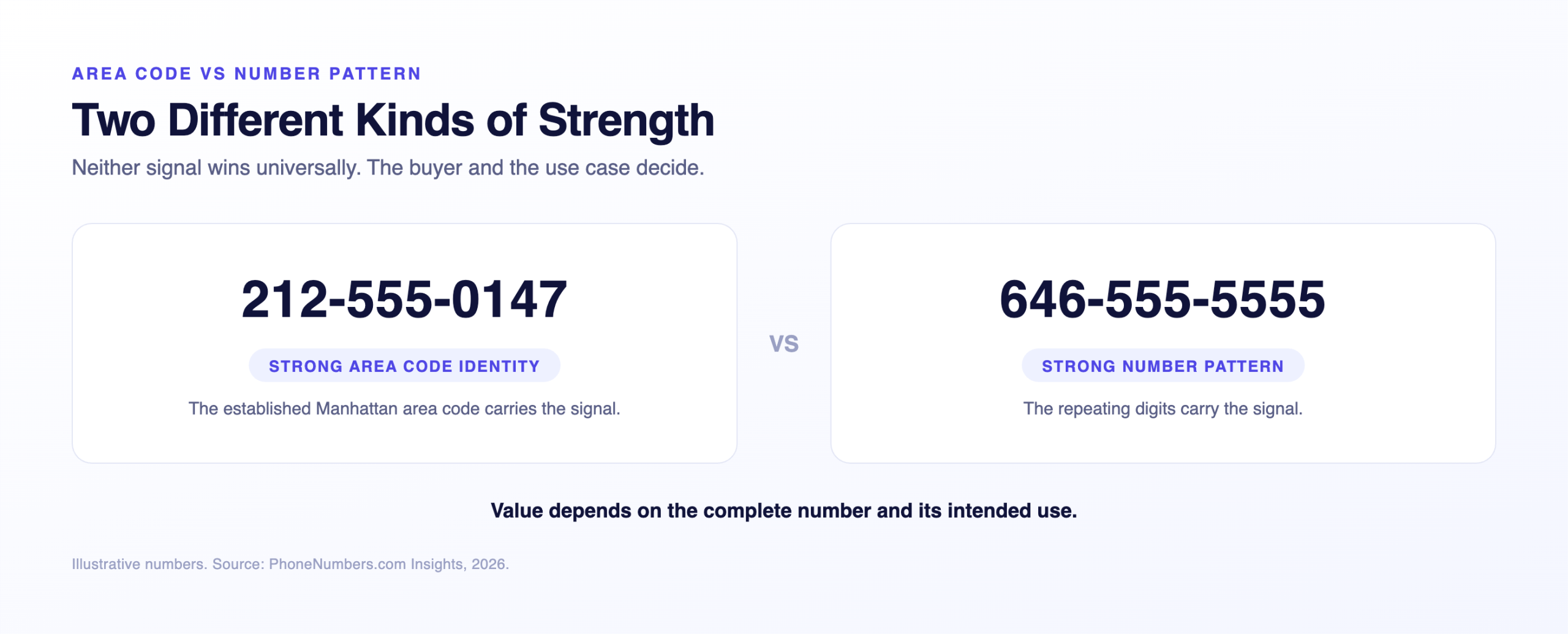
This is one of the more interesting questions in phone number valuation. Consider 212-555-0147 versus 646-555-5555. The first carries the established 212 Manhattan identity. The second carries an exceptionally memorable pattern.
Which is more valuable? There is no universal answer. The buyer who specifically wants a 212 presence may choose the first. A business prioritizing recall may choose the second. A third buyer might reject both because neither matches the company’s brand.
This is why evaluating only the area code can be misleading. The area code establishes context. The remaining seven digits establish character. The strongest numbers can combine both.
What About Toll-Free Numbers?
Toll-free numbers introduce another dimension. With prefixes such as 800, 888, 877, 866, 855, 844 and 833, the area code is not signaling local geography. Instead, the prefix itself can become part of the number’s identity.
And within toll-free numbering, the same principles still apply: prefix, pattern, vanity potential, memorability, scarcity and utility. An established 800 prefix paired with a memorable word or pattern may be evaluated differently from an otherwise random toll-free number. That makes toll-free numbering particularly useful for studying the interaction between prefix identity and complete-number quality.
Read: 800 vs 888 vs 877, Which Toll-Free Prefix Is Best? →
Vanity Numbers Add Language to the Equation
Vanity numbers replace some or all of the numeric sequence with letters corresponding to telephone keypad digits. Famous examples include formats such as 1-800-FLOWERS, and hypothetical industry terms such as 1-800-PLUMBER.
The value proposition is different from a purely numeric premium number. Instead of relying only on numeric pattern recognition, the number can communicate a word, brand, category or action. That can make the telephone number function more like a piece of advertising.
But vanity numbers introduce their own valuation questions. How strong is the word? How commercially relevant is it? Is it easy to spell? Does the phrase map cleanly to the keypad? Is the corresponding number memorable? What prefix accompanies it? Again, the complete number matters.
Can Phone Number Value Be Measured?
This is where the subject becomes particularly interesting for PhoneNumbers.com. Some characteristics are objective. A system can determine area code, geography, whether an area code is an overlay, number pattern, repeated digits, sequences, vanity possibilities and number structure.
Other characteristics can be informed by marketplace data: relative demand, transaction history, comparable marketplace behavior, scarcity of comparable numbers and historical trends. And other factors remain highly contextual: buyer-specific utility, brand fit and strategic importance.
That means a useful valuation system should not pretend that one formula produces an unquestionable answer. Instead, it should identify and analyze the signals that contribute to value. That is a much more defensible approach.
From Phone Number Value to Number Intelligence
Historically, people have evaluated premium numbers largely by looking at them. Experienced buyers and sellers can recognize a good pattern, a strong area code or a memorable vanity number quickly. But those judgments can increasingly be supplemented with structured data.
Imagine analyzing a number across multiple dimensions: its geography, its area code and area code type, its pattern, its memorability, its marketplace demand signal, its scarcity relative to comparable numbers, its vanity potential. No single dimension establishes value. Together, they create a number intelligence profile.
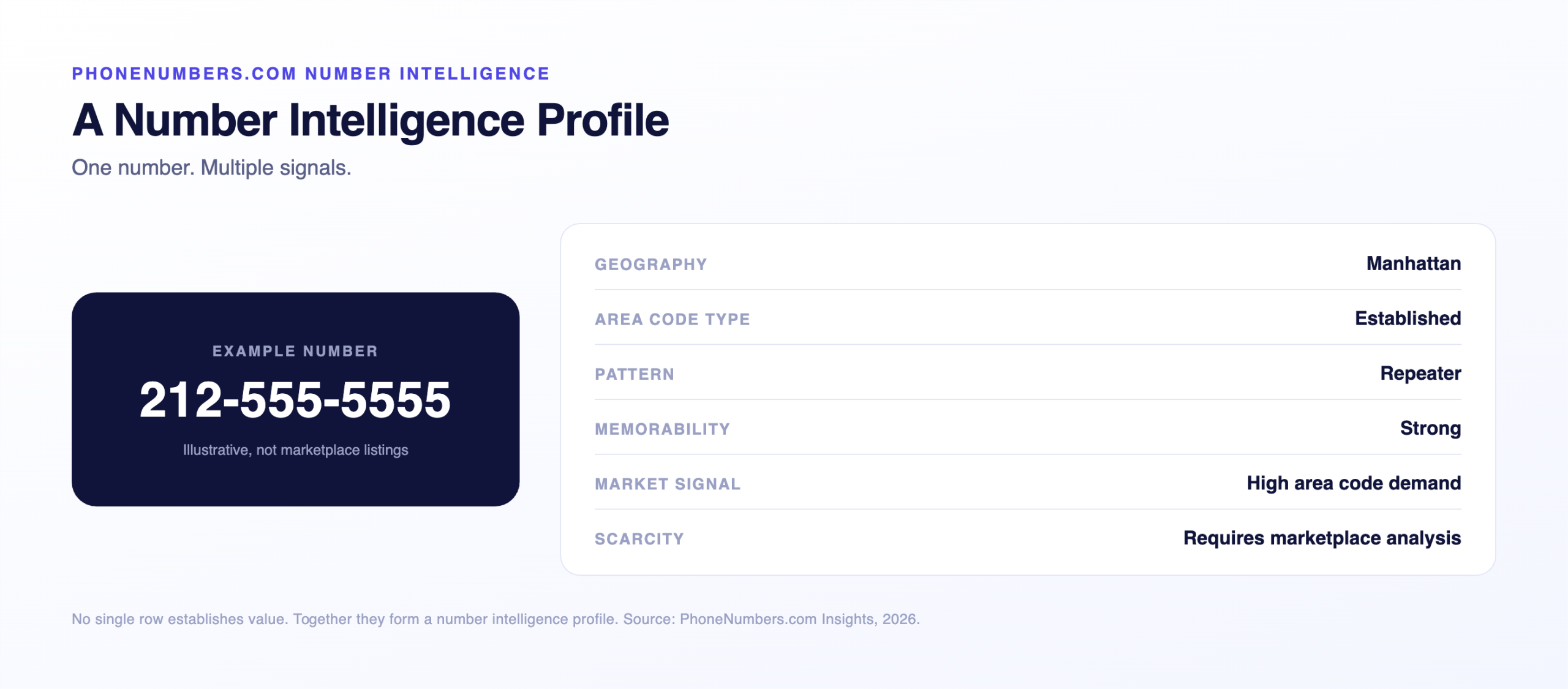
That is where PhoneNumbers.com is heading: making the characteristics behind phone numbers more structured, understandable and useful.
A Framework for Evaluating Any Phone Number
When evaluating a number, ask these questions in order.
What does the area code communicate?
Does geography matter to the intended user?
Is the complete number memorable?
Can someone easily hear it, remember it and repeat it?
Does it contain a recognizable pattern?
Repetition, sequences and structured digit groups can distinguish one number from another.
How scarce are comparable numbers?
Do not ask whether the individual number is unique; it always is. Ask how many comparable alternatives exist.
Does it have specific business utility?
Does the number communicate a brand, service, location or memorable identity?
What does marketplace behavior tell us?
Are buyers demonstrating demand for similar characteristics?
The strongest valuation decisions consider all six, rather than anchoring on one.
Frequently Asked Questions
What makes a phone number valuable?
Phone number value can be influenced by several characteristics, including area code, memorability, digit patterns, scarcity, business utility and marketplace demand. No single characteristic determines the value of every number.
Are repeating phone numbers worth more?
Repeating digits can make a phone number more memorable and scarce relative to random digit combinations. Whether that translates into a higher market price depends on the complete number and buyer demand.
Are 212 phone numbers valuable?
The 212 area code has a long-standing association with Manhattan and ranked No. 2 in PhoneNumbers.com’s 2026 marketplace study by relative purchase activity. That does not mean every 212 number is valuable or that 212 numbers have a uniform market price.
Is an old area code better than a new overlay?
Not necessarily. The 2026 marketplace rankings included newer overlays near the top, including 747 at No. 3 and 929 at No. 4. Area code age is only one potential signal.
Are vanity phone numbers valuable?
A strong vanity number can provide business utility by making a phone number easier to remember or by communicating a brand, category or service. The quality of the word or phrase, the prefix, availability and buyer demand can all matter.
Is a phone number’s value the same as its price?
No. Price is the amount associated with a particular transaction. Value can include scarcity, utility, memorability, identity and buyer-specific considerations. The two concepts are related but should not be treated as identical.
Can PhoneNumbers.com tell me what my phone number is worth?
PhoneNumbers.com is developing tools and research to better understand the characteristics and marketplace signals associated with phone number value. No automated estimate should be treated as a guaranteed sale price.
About PhoneNumbers.com Number Intelligence
Every phone number contains information. Its area code can reveal geographic context. Its digit structure can contain patterns. Its history can reflect changes in the numbering system. Marketplace behavior can provide additional signals about demand and scarcity.
PhoneNumbers.com Number Intelligence is being built to bring those signals together. Our goal is to make phone number data easier to understand, analyze and eventually access programmatically, helping businesses move beyond the digits to understand the intelligence behind the number.
Explore Number Intelligence → Explore Phone Number Market Research →
Search Available Phone Numbers →
More from PhoneNumbers Insights
Area codes
- America’s Most In-Demand Area Codes of 2026
- 212 vs 646 vs 917: Understanding New York’s Most Recognized Area Codes
- The Original Area Codes: Why Legacy Codes Still Matter
- The Intelligence Behind an Area Code
Toll-free numbers
- 800 vs 888 vs 877: Which Toll-Free Prefix Is Best?
- The Evolution of Toll-Free Numbers: From 800 to 833
- Local vs Toll-Free Numbers: Which Is Right for Your Business?
Choosing & buying a number
- How to Choose a Business Phone Number
- How to Get a Vanity Phone Number for Your Business
- The Anatomy of a Memorable Phone Number